
Why it matters
The producer
Le Ragnaie farms 28 hectares inside the municipality of Montalcino, planting every row to Sangiovese and spreading its parcels across three distinct corners of the appellation. The estate was founded in 1991 and produced creditable wine, but it was Riccardo Campinoti who bought it in 2002 and decided to turn it into something more ambitious.
Riccardo and his American wife, Jennifer, did not stop at the original holding. They searched out parcels in terroirs they admired around the appellation and added vineyards in Fornace to the south, in the cru of Montosoli to the north, and in the high-altitude site of Petroso. The strategy was deliberate: by owning land in geographically separate corners of Montalcino, they could compare what the same grape and the same cellar work would express in different soils and elevations. That comparative logic now organises the whole range.
Place and vineyards
Where the wines begin
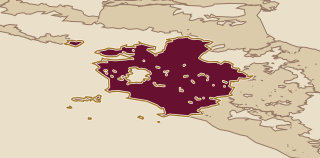
Montalcino sits on a hill in southern Tuscany, southeast of Siena, and its name on a label means a single grape: Sangiovese, grown inside a tightly drawn appellation and aged under rules that set Brunello di Montalcino apart from other Tuscan reds. The hill faces multiple directions, rises above 500 metres at its highest points, and carries soils that shift from clay-rich galestro in the cooler northern and northeastern sectors to sandier, warmer ground in the south toward Castelnuovo dell'Abate.
The vineyards follow organic-agriculture guidelines. No synthetic fertiliser goes into the ground; instead, cover crops are planted in autumn and turned in to feed the soil naturally through the winter. Vine ages in the home vineyard range from five to forty years, giving the estate a mix of youthful energy and older-vine depth in the same parcel.
In the cellar
Vineyards and cellar
All fermentation takes place in concrete tanks, with indigenous yeasts cultivated from the estate's own grapes to start each vintage. Macerations are long: somewhere between 25 and 90 days depending on the vintage character, with the extraction kept gentle so tannin integrates rather than dominates. Concrete holds temperature steadily and adds nothing to the wine, leaving the Sangiovese character direct and undisguised.
After fermentation, the wine moves into large Slavonian oak barrels. Brunello spends roughly three years or more in large Slavonian oak before bottling. Sangiovese develops complexity through time in barrel rather than through oak extraction, arriving in bottle with the grape's natural red-fruit and dried-herb character intact.
Wines to know
The range in view
The estate Brunello di Montalcino is Le Ragnaie's widest lens: a blend drawing fruit from Fornace, Montosoli and the home vineyards, vinified and aged identically to the single-vineyard bottles. It reads as Montalcino from multiple directions at once, with tart cherry, dried rose, iron and firm but granular tannin, and enough acidity to age for well over a decade.
Ragnaie V.V. comes from old vines at 600 metres in the home vineyard. The elevation gives the wine a cooler, tighter character: tighter fruit, a stronger mineral thread, and a finish that holds longer and leaner than the estate blend. It is the most site-specific bottle in the range.
A useful way in
A bottle to begin with
Start with the estate Brunello di Montalcino. It brings fruit from all three of Le Ragnaie's growing areas into a single wine, vinified in concrete with indigenous yeasts and aged for three or more years in large Slavonian oak. In the glass it shows dried cherry, rose petal and dried herbs on the nose, then a firm, structured mid-palate with high acidity and granular tannin that softens over the first hour in the glass. There is no oak sweetness, no cosmetic texture: this is Sangiovese on Montalcino soil, expressing the hill across multiple elevations and aspects. Open it with a few years of age on it and decant before serving.