
Why it matters
The producer
Marco de Grazia already had Tenuta delle Terre Nere, a north-Etna estate with parcels across several of the volcano's most argued sectors, when he started something smaller alongside it. Le Vigne di Eli was founded in 2006, not as a commercial extension but as a gift for his daughter Elena. The whole project takes its name from her.
Elena drew the labels from the first vintage and has continued designing them since. That detail is not incidental: the drawings are the clearest outward sign that this is a different kind of estate from Terre Nere, built at a scale where 8,000 bottles a year is the ceiling and every parcel is chosen for what it gives rather than what it covers. A portion of the proceeds goes to the Meyer Pediatric Foundation Hospital in Florence.
Place and vineyards
Where the wines begin
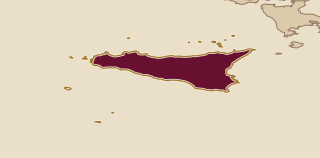
Mount Etna rises from the eastern coast of Sicily to just over 3,300 metres, and the vineyards of the north slope sit between roughly 600 and 1,000 metres altitude. That height changes everything about how grapes ripen here. Temperatures drop sharply at night even in summer, pushing growing seasons later than elsewhere in Sicily and holding acidity into the fruit long after the sugars have climbed.
The soils are volcanic throughout: layers of dark basalt and mineral-rich ash laid down by successive eruptions over centuries. They drain freely and force vines to root deeply for water, which concentrates flavour without adding weight. The combination of altitude, volcanic soil and Atlantic-facing exposure on the north slope makes Etna one of the few places in the Mediterranean where both a white wine grape and a red wine grape can produce bottles with cool-climate acidity alongside southern ripeness.
In the cellar
Vineyards and cellar
All the vineyards are organically farmed and planted with native Etna varieties. No other grape enters the range: Carricante for the whites, Nerello Mascalese for the reds. The choice to work only with native varieties on a volcano already known for them is a production constraint that keeps every wine rooted in the same narrow genetic and geographical territory.
Fermentation happens without inoculation, using the ambient yeasts present on the grape skins and in the cellar. This approach slows fermentation and produces wines with more variable aromatic character vintage to vintage, but it also means the yeast population reflects the vineyard rather than the laboratory. For the Moganazzi-Voltasciara red, wood ageing runs to approximately 14 months in barriques, adding mild tannin grip and slight toasty depth without overwhelming the fruit or the mineral character that comes from the volcanic soil.
Wines to know
The range in view
The range has four wines. Two are white, both from 100% Carricante: the estate-level Etna Bianco and the Moganazzi-Volta Sciara Etna Bianco. Carricante is Etna's main white grape, a variety with firm natural acidity, a saline mineral quality on the palate and enough dry extract to carry age. Both white wines are vineyard expressions of the same grape; the Moganazzi-Volta Sciara version draws from the named north-slope sector and shows a sharper, more concentrated character.
The Carricante whites open with citrus and light floral lift, then settle into a firm, saline mid-palate with a dry, almost chalky finish. The acidity is pronounced rather than soft, giving the wines a clean, driving quality and a taut first sip.