
Why it matters
The producer
Le Vigne di Zamò farms three separate terroir clusters across the Colli Orientali hills southeast of Udine: Rosazzo, where the estate is based; Buttrio, where the oldest vines grow; and Rocca Bernarda, where the family first planted in 1978. Together they cover roughly 65 to 67 hectares, and keeping them distinct shows up directly in the cellar, where different vineyard lots are handled separately before being brought together.
Pierluigi Zamò leads the estate today. The Zamò family's connection to Manzano goes back to 1924, when Luigi Zamò opened an osteria in the village. The wine estate came later. The cellar's approach is traditionally minded: no herbicides, no shortcuts in the vineyard, and an eight-month lees élevage for the flagship white that rewards patience over extraction. Organic certification arrived formally in 2021, confirming practices the family had followed for years.
Place and vineyards
Where the wines begin
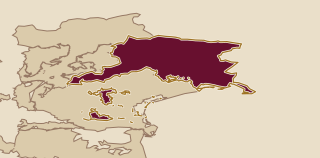
Friuli Venezia Giulia occupies the northeastern corner of Italy, bordered by Slovenia to the east and the Adriatic to the south. The Colli Orientali, the eastern hills, form a band of Prealps ridges running roughly from Tarcento in the north down toward Manzano. The underlying rock is Eocene flysch, a layered alternation of marl and sandstone called ponca in local dialect. It drains well, holds warmth through the afternoon, and gives the wines a mineral grip that stays through the finish.
The climate is continental with Adriatic moderation: warm growing seasons, cool nights, and enough diurnal range to preserve acidity in grapes that ripen fully. Friulano, the white variety that defines the Colli Orientali, produces wines with stone fruit, dried herbs, and a faintly nutty character on ponca soils. The Rosazzo sub-zone, where Le Vigne di Zamò is headquartered, carries DOCG status for certain white blends. The estate bottles its wines under the broader Friuli Colli Orientali DOC.
In the cellar
Vineyards and cellar
The oldest vines at Buttrio anchor the red range: Merlot, Cabernet, and Refosco dal peduncolo rosso grown on five estate-owned hectares. Refosco dal peduncolo rosso is a northeastern Italian variety with firm natural tannin, high acidity, and dark fruit character. Its inclusion in the Zamò Rosso blend gives the wine grip and longevity that Merlot and Cabernet alone would not supply.
For No Name Friulano, each vineyard lot is settled overnight after harvest, then fermented and aged separately before the lots are combined. The unified wine then spends eight months on fine lees with weekly bâtonnage, stirring the spent yeast cells back through the wine to build texture and mid-palate weight without adding oak character. The wine spends eight months on fine lees with weekly bâtonnage.
Wines to know
The range in view
No Name Friulano is the estate's primary white: 100 percent Friulano from multiple vineyard sites, lots handled separately through fermentation, then combined and aged eight months on fine lees. Stone fruit, dried herbs, and a nutty, mineral finish characterise the style. The lees contact adds weight without heaviness, and the multi-site blending gives the wine more aromatic range than a single-parcel bottling would.
Zamò Orange is Malvasia delle Venezie after six months of skin maceration in amphora. The 2021 release shows apricot, chamomile, and orange peel on the nose, with a lightly tannic, pleasantly bitter finish. The tannin here comes from the grape skins rather than oak, giving the wine a drying texture that works as a food partner in a way conventional white Malvasia does not.
A useful way in
A bottle to begin with
Start with No Name Friulano. It is 100 percent Friulano, the grape that defines the Colli Orientali, grown across three terroir clusters and aged eight months on fine lees. Stone fruit and dried herbs come first, then the textural mid-palate that the extended bâtonnage builds, then a mineral, nutty finish that stays. No oak. No residual sweetness. The wine is the estate's three-terroir farming and its traditional cellar approach in a single bottle, and it shows more clearly than any other release what Friulano on ponca soils actually delivers.