
Why it matters
The producer
Les Caves Richemer is a large coastal cooperative whose wines carry IGP Pays d'Oc and Côtes de Thau designations. The Marseillan cooperative dates to 1934, when its vineyards were already closely associated with white and rosé wine. That history remains visible in the current range: Piquepoul brings citrus, white flowers and refreshing acidity, while Terret Blanc gives a crisp, fresh wine with naturally low alcohol and high acidity.
Head winemaker Florian Masson uses temperature-controlled stainless-steel tanks to retain primary fruit and freshness. The cellar method suits the grapes and the coast, keeping the wines direct, bright and easy to place in the glass.
Place and vineyards
Where the wines begin
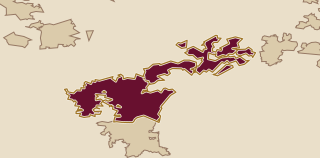
Agde and Marseillan sit beside the Thau lagoons, where Mediterranean warmth meets air moving in from the sea. The coastal setting helps preserve acidity during hot summers, so Piquepoul can keep its citrus lift and Terret Blanc can remain light on its feet. The IGP Côtes de Thau designation gives the label a direct coastal address, while IGP Pays d'Oc allows the cooperative to work with a wider range of wines and grapes.
The seahorse emblem refers to the Thau lagoon and its regional biodiversity. On the bottle, it turns the local landscape into a simple visual marker.
In the cellar
Vineyards and cellar
Piquepoul and Terret Blanc are planted in the coastal vineyard network, where clay-limestone soils and sea air protect acidity through warm Mediterranean conditions. Piquepoul gives bright citrus and white floral notes. Terret Blanc brings a crisp, fresh palate with naturally low alcohol and high acidity.
In the cellar, Florian Masson works with temperature-controlled stainless-steel tanks. The controlled fermentation protects primary fruit and keeps the wines' citrus, floral and red-fruited notes clear instead of covering them with oak flavour.
Wines to know
The range in view
The range is led by white wine. Piquepoul is the most citrus-led white, with white flowers and refreshing acidity. Terret Blanc follows with a crisp, fresh style, lower in alcohol and higher in acidity. Both varieties suit the coastal setting because their fruit remains bright while sea breezes preserve freshness.
Rosé represents one quarter of production. La Généreuse Francine 2025 is the fruit-forward option, with peach, watermelon, grapefruit and raspberry in the bouquet, followed by tart red berries, rhubarb, citrus and raspberry on the palate. Henri de Richemer Marselan offers a different rosé shape: pale colour with grey undertones, a citrus nose opening onto grapefruit, bright acidity, a lightweight mouthfeel and a pleasant finish.
A useful way in
A bottle to begin with
La Généreuse Francine 2025 is the first bottle to open. It carries the cooperative's strong rosé tradition in a clear, approachable form, with a fresh bouquet of peach, watermelon, grapefruit and raspberry. The palate is youthful and very fresh, moving through tart red berries, raspberry, peach, rhubarb and citrus.