
Why it matters
The producer
The Pira family has farmed Serralunga d'Alba since the end of the nineteenth century. For the better part of that time, the wine left the estate without a name on it. Grapes or bulk wine went to the trade; the parcels stayed in family hands, year after year, decade after decade, on the limestone clay soils associated with Serralunga. That changed when Luigi's three sons, Gianpaolo, Romolo and Claudio, joined in the early 1990s. The first Luigi Pira Barolo appeared in 1993, from two crus the family had been farming all along: Margheria and Marenca. Vigna Rionda followed four years later.
The estate now farms approximately 12 to 13 hectares of Nebbiolo, Dolcetto and Barbera in the commune. Gianpaolo oversees both viticulture and winemaking. Romolo manages the vineyards, working without herbicides and holding yields low to concentrate the fruit in each parcel. The family team has grown to include Gianpaolo's wife Tiziana and daughters Annalisa and Elena, who handle work across the vineyards, the cellar and the tasting room. Annual production runs to roughly 50,000 to 60,000 bottles.
Place and vineyards
Where the wines begin
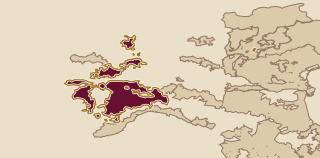
Serralunga d'Alba sits at the southeastern end of the Barolo production zone in Piemonte, and its soils set it apart from most of its neighbours. The limestone-rich clay, Helvetian in origin, produces wines with notably firm tannin, deep colour and the kind of compact fruit that needs time in the bottle before it opens. Where communes such as La Morra and Barolo tend toward rounder, more immediately expressive Nebbiolo, Serralunga Barolo typically carries more grip and a longer arc of development. The appellation rules require a minimum of two years ageing before release, with a further year for Riserva, but Serralunga wines often need more than the legal minimum.
Romolo's decision to farm without herbicides and to keep yields low compounds what the soil already does: less fruit per vine means more concentration in each grape, and each grape matters more to the final bottle.
In the cellar
Vineyards and cellar
Romolo manages the vineyards, working without herbicides across the Serralunga parcels. The choice matters practically: herbicides compact soil over time and reduce the biological activity that helps limestone clay maintain its drainage. Low yields keep each vine's output small enough that the remaining fruit ripens more evenly and builds more concentration per grape.
The communal Barolo comes from multiple parcels across the Serralunga holdings, fermented in steel, then aged for 24 months in large cask. The single-cru Barolos follow a similar pattern at the cellar level but are kept separate from first selection through to bottling, so that Margheria, Marenca and Rionda each arrive in the bottle as a distinct expression of their parcel.
Wines to know
The range in view
The range opens with the Dolcetto d'Alba, 100% Dolcetto from Serralunga parcels, vinified in steel. It is the most immediate wine in the lineup: fresh, purple-fruited, with soft tannin and enough acidity to make it work at the table without demanding any particular occasion. Drink it young.
The Barolo del Comune di Serralunga d'Alba is the communal-level Barolo: Nebbiolo blended from across the estate's Serralunga holdings, fermented in large vessels and aged in oak. Deep ruby, full-bodied, firm tannin. It gives access to the Serralunga character without requiring a commitment to a single-cru bottle at a higher price point.
A useful way in
A bottle to begin with
Start with the Barolo del Comune di Serralunga d'Alba. It is 100% Nebbiolo drawn from multiple parcels across the estate's Serralunga holdings: fermented in steel, aged in large cask, and bottled as a communal wine. Deep ruby in the glass, with the characteristic Serralunga tannin firm and present from the first sip. Dried roses and tar on the nose, dark cherry and mineral on the palate, a long dry finish. The single-cru bottles go deeper and cost more; this one gives access to the same limestone clay, the same low-yield viticulture, and the same family winemaking at a price that invites repeat buying.