
Why it matters
The producer
Lungarotti did not simply move into Torgiano. It created the address. When Giorgio Lungarotti formally established Cantine Lungarotti in 1962, Torgiano was a small hilltop town in central Umbria with no wine classification of its own. Over the following decade, he farmed, bottled, and argued until the appellation existed on paper. Torgiano received DOC status in 1968, and the Torgiano Rosso Riserva was elevated to DOCG in 1990. Lungarotti remains the only producer entitled to that DOCG designation.
The estate today sits across two addresses 20 kilometres apart. The original 230 hectares surround Torgiano, roughly midway between Perugia and Assisi. The second estate at Montefalco, acquired in 2001 and now certified organic, adds 20 hectares of Sagrantino and Sangiovese. Giorgio's daughters Chiara and Teresa now lead the company: Chiara as CEO, Teresa in marketing and communications, her Bordeaux enology training shaping the technical direction. A third generation has joined: Teresa's son Francesco as export director, her daughter Gemma with the Lungarotti Foundation and its museums.
Place and vineyards
Where the wines begin
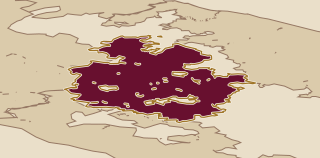
Torgiano sits in the Tiber Valley in southern Umbria, a landlocked region of forested hills, olive groves, and medieval towns. The town itself is compact and elevated, positioned between the Tiber and Chiascio rivers on a plateau that moderates summer heat and reduces the risk of frost. Umbria's continental climate pushes Sangiovese toward firm acidity and moderate tannin, and the altitude of the Torgiano plateau prolongs the growing season enough to develop fruit concentration without overripeness.
Montefalco, 20 kilometres to the south, is a different proposition. The DOCG zone for Montefalco Sagrantino sits higher and cooler, and the indigenous Sagrantino grape there produces wines of extreme tannin density, dark fruit, and considerable ageing demand. Lungarotti planted Sagrantino at Montefalco from 2001, placing the estate inside both of Umbria's most significant red wine appellations. The Torgiano side of the range is dominated by the DOCG label, Rubesco Riserva Vigna Monticchio. The Montefalco side gives the range its most powerful wine.
In the cellar
Vineyards and cellar
Yields at Lungarotti are set by wine tier, not uniformly across the estate. Rubesco and Rosso di Montefalco are targeted at 2 kilograms per vine. Rubesco Riserva Vigna Monticchio, San Giorgio, and Sagrantino all drop to 1 kilogram per vine. That reduction concentrates colour, tannin, and fruit intensity in the wines that receive the longest ageing.
Harvest combines mechanical and manual picking, with timing determined by measurements of sugar, acidity, pH, and, for red grapes, polyphenols. The polyphenol test matters for Sagrantino in particular: the variety carries some of the highest natural tannin levels of any cultivated grape, and picking too early or too late shifts the balance between bitter grip and dry tannin in ways that define whether the wine ages gracefully or not.
Wines to know
The range in view
The range divides cleanly between Torgiano and Montefalco.
Rubesco (Torgiano DOC Rosso) is Sangiovese blended with Colorino, a small dark-skinned grape that deepens colour and is part of the blend. Fifteen days of maceration gives the wine cherry fruit, mid-weight body, and enough grip to hold over the two-year ageing before release. It is the approachable entry to the Torgiano tier.
A useful way in
A bottle to begin with
Rubesco Riserva Vigna Monticchio is the bottle to begin with. It is a single-parcel Sangiovese from Torgiano at the DOCG level: the wine that Giorgio built the appellation around, grown in the same named Monticchio vineyard that has given Lungarotti its central argument since the 1960s. In the glass it delivers concentrated dark cherry and dried spice, firm tannin that has integrated over its ageing period, and a long finish with enough acidity to keep the fruit lively. It is not a wine for instant drinking, but it explains what Lungarotti set out to prove: that Torgiano could produce a red of serious depth.