
Why it matters
The producer
Oreste De Santis founded Macchie Santa Maria Cantine in 2010, but the grape-growing started long before the labels did. His family had been cultivating Aglianico, Fiano, and Greco on the volcanic hillsides above Montemiletto for three generations, making wine for their own table and keeping the knowledge entirely to themselves. When De Santis finally formalised the estate, he did not change what the family grew or where: he applied commercial production methods to an inherited practice and began placing those same native varieties into bottles for sale.
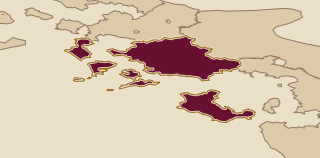
The winery sits in Montemiletto, a hill town in Irpinia, the inland wine country of Campania in southern Italy. Irpinia is where Campania's three most important DOCG denominations converge, and Macchie Santa Maria works all three: Taurasi from Aglianico, Fiano di Avellino from Fiano, and Greco di Tufo from Greco. Those three grapes are the only varieties the estate uses.
Place and vineyards
Where the wines begin
Irpinia occupies the Apennine hills inland from Naples, at elevations and latitudes that produce something quite different from the coastal Campania most visitors picture. The zone is cooler, more austere, and marked by volcanic soils deposited over millennia across steep hillsides. That combination of altitude, slope, and volcanic subsoil shapes Irpinia's native grapes: Aglianico builds firm tannin and high acidity because the long, slow growing season on these hills delays phenolic ripeness deep into autumn; Fiano retains its aromatic lift and freshness because the nights are cold enough to preserve it; Greco holds its mineral character from the volcanic and tuffaceous soils around Tufo.
The Taurasi Aglianico grows at roughly 450 metres above sea level with a southeast-facing exposure. That orientation captures morning sun while the vine cools through the afternoon, extending the ripening arc and allowing the grape's natural acidity and tannin to develop alongside fruit ripeness.
In the cellar
Vineyards and cellar
The Taurasi Aglianico vines are approximately 20 years old, old enough to have established deep root systems in the volcanic subsoil and to produce grapes with concentrated flavour rather than abundant yield. The official vinification programme for the Piana delle Macchie Taurasi begins with 12 months in stainless steel, followed by at least 24 months in oak casks, and a further 12 months in bottle before release. That is a minimum of four years from harvest to sale, the kind of programme that transforms the raw tannin and dark fruit of young Aglianico into something more layered and age-worthy.
Fiano di Avellino is a fragrant, aromatic white that ferments cool to preserve its characteristic floral and stone-fruit notes. Greco di Tufo from the Tufo zone carries more weight and mineral density, shaped by the sulphurous soils around the village.
Wines to know
The range in view
Macchie Santa Maria produces three DOCG wines, one for each of Irpinia's principal native varieties.
The Piana delle Macchie Taurasi DOCG is the most demanding bottle in the range. Pure Aglianico from 20-year-old vines, it spends at least 24 months in oak before a further year in bottle, which smooths Aglianico's naturally firm tannin without removing it. The wine is dark, firmly structured, and built for ageing: black cherry, dried herbs, graphite, and a long dry finish are the characteristics associated with well-made Taurasi, and the extended oak and bottle rest give them time to integrate.
A useful way in
A bottle to begin with
Start with the Piana delle Macchie Taurasi DOCG. It is pure Aglianico from 20-year-old vines on volcanic hillside soil, aged for at least 24 months in oak and a further 12 months in bottle. That programme is long enough to soften Aglianico's aggressive young tannin and let the wine's dark fruit, dried herb, and earthy mineral character settle into something coherent. The acidity stays high throughout, giving the wine lift and length on the finish. It is the bottle where the volcanic soils, the extended growing season, and the De Santis family's long experience with Aglianico come together most clearly: serious, dry, firmly structured, and built to last several more years in a good cellar.