
Why it matters
The producer
Maeli is an organic wine estate on Monte Pirio in the Colli Euganei, the cluster of volcanic hills that rise southwest of Padua in the Veneto. Elisa Dilavanzo owns and farms 24 hectares inside the Euganean Hills national park, and she has built the estate almost entirely around one grape: Moscato Giallo, a variety the rest of Italy reaches for mainly when making light, sweet frizzante. Dilavanzo does not do that. She vinifies many of her Moscato Giallo wines dry, and she makes a traditional-method sparkling whose secondary fermentation occurs in bottle rather than in tank.
Maeli holds two appellations. The Colli Euganei DOC covers the estate's broader range, while the Colli Euganei Fior d'Arancio DOCG is the designated label for Moscato Giallo wines from this zone. The DOCG name, Fior d'Arancio, translates as orange blossom, which is one of the aromas the grape reliably produces on volcanic ground.
Place and vineyards
Where the wines begin
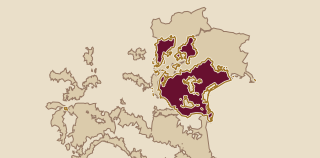
The Colli Euganei are volcanic hills southwest of Padua. The hills appear without geographical preparation in the flat Veneto plain southwest of Padua, isolated remnants of ancient volcanic activity. Monte Pirio is one of the higher points in the range, and the national park boundary runs through the vineyards. That protection shapes what can and cannot be done on the slopes: organic certification, which Maeli achieved in 2020, fits naturally into a farming context where the surrounding land is already managed for conservation.
The volcanic origin of the hills is what drives Dilavanzo's choice of grape. Moscato Giallo on volcanic ground develops a mineral sharpness and aromatic lift that the variety does not show in flatter, more alluvial soils. The Colli Euganei soils at Maeli carry sandstone, chalk, clay, marl, and loam over the ancient volcanic base.
In the cellar
Vineyards and cellar
Farming on Monte Pirio follows organic principles across all 24 hectares, with vine ages up to 28 years giving the oldest parcels some root depth into the volcanic subsoil. The mixed soil profile, sandstone, chalk, clay, marl, and loam, produces grapes with layered aromatic character rather than one dominant note, which is part of why the dry vinifications work: there is enough soil complexity to give the wine somewhere to go beyond floral sweetness.
Wines to know
The range in view
Moscato Giallo runs through everything Maeli makes. The range splits broadly into three styles. The dry still Moscato Giallo wines carry the Colli Euganei DOC or the Fior d'Arancio DOCG designation depending on the level and the wine law, and they offer Moscato Giallo at its most demanding: no residual sweetness, the full aromatic profile of the grape exposed against the volcanic soil character, and the acidity that the Colli Euganei altitude provides. These are wines that need food or at least attention; they are not aperitivo bottles.
The traditional-method sparkling is the more unusual proposition. Bottle fermentation adds texture and yeast-derived breadth to a grape more often associated with gentle froth. The mousse is finer and more integrated, and the wine develops a secondary flavour layer that tank-fermented versions of Moscato simply do not reach.
A useful way in
A bottle to begin with
Dilì is the right first bottle. It is an 11% sparkling Moscato Giallo made to be immediately readable: preserved white peach, wildflower, sweet spice, and sage on the nose, a light, lively palate with low sweetness and clean acidity, and a finish that rises rather than fades into heaviness. The alcohol is low enough to drink through the afternoon without effort, and the aromatic character of Moscato Giallo from volcanic soils is clear from the first pour. Dilì does not ask for food or knowledge to enjoy.