
Why it matters
The producer
Marchesi di Barolo sits at the bottom of the village of Barolo, its cellars directly below the Renaissance castle that gave the wine its name. The estate's claim is unusual and specific: Barolo as a dry, still wine was first made here, in these cellars, in the first half of the nineteenth century. Before that, Nebbiolo from the Langhe hills was sweet and sparkling.
The change was Giulia Falletti's decision. Born Juliette Colbert in France, she married Carlo Tancredi at Versailles in 1806 and moved to Turin in 1814, taking an Italian name and turning her attention to the vineyards around the family castle. She saw what the hillside parcels could do with the right cellar, commissioned new buildings designed for large-cask fermentation, and insulated them against the cold of late autumn when Nebbiolo came in. The wine that came out was dry, still and serious.
Place and vineyards
Where the wines begin
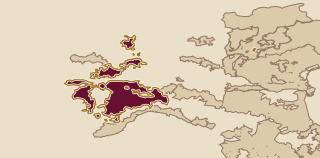
Barolo is a small hilltop village in the Langhe, the ridge and valley landscape south of Alba in Piemonte. The appellation named after it covers Nebbiolo grown across eleven communes; the Cannubi hill, one of the parcels within those boundaries, sits in Marchesi di Barolo's vineyard holdings.
Beyond Barolo, the estate's vines spread across the Langhe, Roero and Monferrato, three adjacent hill zones that together define the heartland of Piedmontese viticulture. Roero sits across the Tanaro river from the Langhe; Monferrato extends further east toward the Po plain. Each zone carries its own appellation framework and its own soils, and growing across all three gives the estate a range that reaches from Barolo and Barbaresco in the south to Barbera country further north.
In the cellar
Vineyards and cellar
Harvests at Marchesi di Barolo are organised parcel by parcel. Each vineyard is picked separately, and where elevation or aspect means one block ripens ahead of another, the timing shifts to match. Across 430 acres in three hill zones, that requires careful scheduling but means each parcel comes in at the moment its fruit is ready rather than at a date fixed by convenience.
The five oak casks associated with Marchesa Giulia were restored in 2002 and returned to Barolo production. They are large-format vessels in the classic Piedmontese tradition, used for long, slow ageing that softens Nebbiolo's firm tannin while preserving its fruit and acidity. Ageing in large old oak imparts no new wood character; the tannin development comes from time and oxygen exchange through the cask staves rather than from the wood itself.
Wines to know
The range in view
Barolo is the estate's anchor. Made from Nebbiolo grown across Langhe parcels including the Cannubi cru, it is the wine the cellars were built to produce. Nebbiolo in Barolo gives a pale garnet colour, high acidity, firm tannin and aromas that shift from fresh cherry and rose to tar, dried flowers and forest floor as the wine ages. The Cannubi site adds concentration and depth.
Barbaresco della Tradizione comes from Cascina Bruciata in the Barbaresco appellation. Also made from Nebbiolo, it carries aromas of dried rose petals, raspberry and tobacco, with firm, lingering tannin. Barbaresco tends to be slightly earlier-drinking than Barolo, though it shares the same grape's structural bones.
A useful way in
A bottle to begin with
Barolo is made from Nebbiolo in the Langhe. The historic cellars of Marchesi di Barolo are where Barolo was created in the first half of the nineteenth century. Five historic oak casks that belonged to Marchesa Giulia were restored in 2002 and returned to Barolo production.