
Why it matters
The producer
Marco Bonfante makes wine in Nizza Monferrato from a grape almost no one else was bothering with. The estate was founded in 2000 by siblings Marco and Micaela Bonfante, and its organising idea is Albarossa, a Piedmontese crossing of Barbera and Nebbiolo created by Professor Giovanni Dalmasso but largely set aside by the region's producers. Marco chose it, dried a portion of the harvest before fermentation, and built a range around what that method produces.
Marco trained at the Oenological School of Alba and runs winemaking, production, and company management. Micaela handles administration and shipping. The family has made wine in Nizza Monferrato for eight generations, though the present estate is a clean break: it was founded after their father Domenico died and his winery was divided between the heirs.
Place and vineyards
Where the wines begin
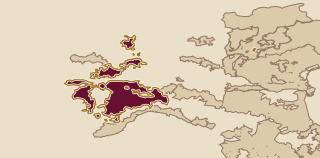
Nizza Monferrato sits in the Monferrato hills of Piedmont, in the province of Asti, south-east of Alba. The Monferrato is an older geological formation than the Langhe, with soils that tend toward clay-limestone and marl. The hill terrain brings warm days and cool nights through the growing season, conditions that allow Albarossa, with its thick skins and dense colour, to build tannin and acidity without losing freshness.
Albarossa is a Piedmontese variety, and the appassimento approach Marco uses is more common in Valpolicella and Abruzzo than in this part of northern Italy. The method concentrates the grape's already deep colour further, which shapes what appears on the label: a Piemonte DOC wine rather than a Nizza DOCG or Barbera d'Asti DOCG, giving the producer latitude over production methods not always available within tighter appellation rules.
In the cellar
Vineyards and cellar
Albarone begins with a 36-to-40-hour cold maceration before fermentation. The low-temperature soak is designed to draw out colour, aromatic compounds, and tannic material from the thick Albarossa skins without the heat that fermentation brings. The resulting wine is then aged in 1,000-litre French oak barrels. The 1,000-litre format sits between a standard 225-litre barrique and a large botte: it imparts less oak flavour per litre than a barrique but more than a large cask, letting wood contribute without marking the wine. For the 2015 vintage, barrel ageing ran to 24 months; the general estate practice is 30 months. After barrel ageing, the wine spends 18 months in bottle before release.
Duedidue, the estate's two-grape blend, has shifted its composition over time. Earlier vintages combined Barbera and Cabernet Sauvignon. By 2021 the blend had moved to Albarossa and Cabernet Sauvignon. The cellar approach across the range keeps wood in a supporting role.
Wines to know
The range in view
The range is organised around Albarossa at the centre, with supporting varietal wines and one blend.
Albarone is 100% Albarossa, made with the two-date appassimento harvest and the extended barrel and bottle ageing described above. It is the estate's most demanding wine to make and its longest to release: the cellar holds it for close to four years before it leaves. Even after release, the estate says the wine only begins showing its real complexity after five or six years in bottle. Its profile runs from dark fruit, firm tannin, and fresh acidity in its younger years toward coffee and cocoa notes with extended bottle time.
A useful way in
A bottle to begin with
Albarone is the bottle to start with. It is 100% Albarossa, made with the two-date harvest, the cold maceration, and the extended French oak ageing that define what this estate does differently from every other producer working with this grape. In the glass it gives dark fruit, firm dry tannin, fresh acidity, and a long finish. It does not ask to be drunk young: buy a recent release and hold it for two or three years, or look for a bottle with five or more years on it to find the coffee and cocoa notes the wine develops. No other producer applies appassimento to Albarossa.