
Why it matters
The producer
The estate traces its foundation to 1816, when Raymond Etienne Amiel won Domaine des Goudous and its 10 hectares of vines in a game. Its long association with fortified wine matters because Mas Amiel’s cellar work is built around fortification, outdoor maturation and old casks, producing bottles whose fruit is shaped by time as much as by the harvest.
Olivier Decelle discovered Mas Amiel in 1999, when the domaine covered 226 hectares, including 155 hectares of vines, and its production was chiefly fortified wine. The present estate is smaller at 100 hectares of vineyard, while its range reaches beyond fortified styles through parcel-based wines and Natural Blanc.
Place and vineyards
Where the wines begin
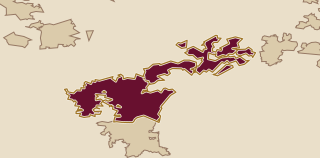
Maury sits in Roussillon, inland from Perpignan. Mas Amiel’s 95 parcels are differentiated by soil, grape varieties and their individual character, so the estate treats its vineyard as a collection of separate growing places rather than one uniform source of fruit.
The figures attached to Mas Amiel belong to different moments: 10 hectares of vines in the 1816 founding account, 155 hectares of vines within a 226-hectare domaine in 1999, and 100 hectares on the current estate page. Read together, they show an estate whose landholding and vineyard footprint have changed while Maury remains the fixed point on the label.
In the cellar
Vineyards and cellar
Mas Amiel received organic certification in 2017 and pursued biodynamic certification for 2020. Its biodynamic approach excludes chemical treatments and includes preparations made at the estate, placing the vineyard’s health ahead of interventions designed to correct fruit later in the cellar.
Grenache is an important grape at Mas Amiel, alongside native varieties and old vines identified by the estate. Parcel separation keeps those grapes distinct before blending decisions, which matters when one wine is intended for immediate fruit and another for extended maturation.
Wines to know
The range in view
The range has two useful poles. The fortified wines carry the estate’s historical method: Vintage Blanc, Rouge 40 Years and 40 Years Old are built around fortification and lengthy oxidative élevage, with old casks giving time a direct role in aroma and finish.
Natural Blanc sits on the other side of the range. Its producer page documents its own vinification, élevage, texture and acidity, so it offers a wine shaped less by decades of oxidative ageing and more by the immediate handling of estate-grown fruit.
A useful way in
A bottle to begin with
Begin with Vintage Blanc. It is a fortified white whose path through outdoor demijohn maturation and historic casks puts Mas Amiel’s most distinctive cellar practice in the glass. The documented 2000 example carries smoke, turmeric, candied tropical fruit and Cointreau-like notes; its sweet, oxidative profile explains why Maury’s fortified-wine tradition remains central even as the estate makes newer styles.