
Why it matters
The producer
In the mid-20th century, when high-yielding French and northern Italian varieties were spreading through southern Italy, Antonio Mastroberardino refused to pull up his native grapes. He initiated a replanting program across Irpinia's hills to preserve and multiply Aglianico, Fiano and Greco. That decision is the reason three DOCGs exist in their current form in this part of Campania.
The family traces its presence in the Irpinia hill country of Campania to the mid-18th century, with Atripalda as headquarters and the location of its historic cellars. Angelo Mastroberardino registered the business with the Avellino Chamber of Commerce in 1878 and began exporting the family's wines. Ten generations have followed without interruption. Piero Mastroberardino, a tenth-generation winegrower and professor of business management, has led the estate since the mid-1990s. The vineyards remain planted almost entirely with native Campanian varieties: Aglianico, Fiano, Greco and Coda di Volpe.
Place and vineyards
Where the wines begin
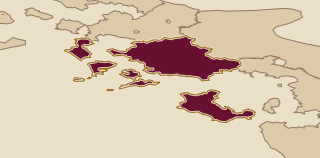
Irpinia is a compact hill country in the Apennine interior of Campania, east of Naples and well away from the coast. The terrain is folded and high, which gives growing conditions closer to central Italy than to the warm Mediterranean flatlands that most people picture when they think of southern Italian wine.
Within Irpinia, three DOCGs occupy different ground. Taurasi is built around Aglianico planted on hillside parcels at elevation, where the late-ripening grape barely reaches physiological maturity before the November harvest. Fiano di Avellino occupies the cooler, higher zones around Avellino, the provincial capital. Greco di Tufo is centred on the village of Tufo, where yellow volcanic tuff defines the soil type and gives the appellation its name. Each DOCG requires different terrain, which is why the estate spreads across Irpinia rather than concentrating on a single village.
In the cellar
Vineyards and cellar
The estate manages its vineyards under both integrated and organic approaches, without claiming full organic certification across all parcels. Field margins are maintained as functional habitat for pollinators and other beneficial organisms, with the effect of increasing biodiversity across the vineyard ecosystem. Fermentation uses indigenous yeast strains selected and isolated from grapes grown on the estate's own vineyards, which ties the fermentation character directly to the site rather than to a commercial strain.
Wines to know
The range in view
The estate produces across all three Irpinian DOCGs, with the Radici range as its flagship tier.
Radici Taurasi and Radici Taurasi Riserva are 100% Aglianico from hillside Irpinia parcels. The Riserva receives the full maceration and oak treatment described above. The producer states an ageing potential of at least 50 years for the Riserva. The standard Taurasi follows a similar profile with less ageing time.
A useful way in
A bottle to begin with
Start with the Fiano di Avellino DOCG. It is 100% Fiano grown on the cool, high-elevation sites around Avellino, fermented in stainless steel and released with its full aromatic character intact. The combination of almond, toasted hazelnut, white flower and citrus zest makes it immediately recognisable as something specific to this part of southern Italy: not Pinot Grigio, not Vermentino, not any of the varieties that fill supermarket shelves from the south. The palate is fuller than the nose suggests, with firm acidity keeping the weight moving and a long, slightly bitter finish.