
Why it matters
The producer
In the 1950s, a woman named Sylla Dogliani was bottling Barolo in Alba at a time when no woman ran a wine business in the area. The local winery association later credited her as the first female entrepreneur in the zone, and she became known as La Dama di Langa. Her son Mauro grew up inside that tradition, then left the family business in 1991 to build his own estate in Alba.
Mauro Sebaste founded his winery with a single goal: produce high-quality wines under his own name. He built around Serralunga d'Alba as the primary source for Barolo, then drew a vineyard map that now covers more than ten communes across Langhe, Roero, and Monferrato Astigiano. His wife Maria Teresa joined the work from the beginning. In 2018, daughters Sylla and Angelica joined the company, completing a three-generation arc with a pioneering woman at each end.
Place and vineyards
Where the wines begin
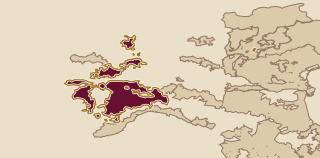
Alba sits at the centre of southern Piemonte, flanked by the Langhe hills to the south and the Roero to the north across the Tanaro river. Most of Mauro Sebaste's vineyard work fans out from this hub across three distinct geographies, each producing wines with a different character.
The Langhe hills, which include the Barolo zone, give Nebbiolo its most serious form: firm tannin, high acidity, and the capacity to age. Serralunga d'Alba, the estate's primary Barolo source, sits at the eastern end of the Barolo appellation, where the compact Helvetian marl produces wines that need time to open. La Morra, Verduno, and Monforte d'Alba contribute Nebbiolo for the multi-terroir Trèsüri Barolo.
In the cellar
Vineyards and cellar
The 30 hectares are farmed across multiple communes, with each site matched to the grape it suits. Nebbiolo for Barolo goes to Serralunga, La Morra, Verduno, and Monforte d'Alba. Dolcetto, Barbera d'Alba, and Nebbiolo d'Alba occupy the Santa Rosalia ridge. Arneis goes to the Roero. Barbera d'Asti and Nizza DOCG come from the Vinchio and Nizza Monferrato parcels.
In the cellar, the approach is deliberately classical. Vinification uses technology to manage temperature and hygiene but no corrective chemicals. Wood contact happens only in large casks and tonneaux, which means slower, gentler extraction of flavour and oxygen than small barriques would give. Wines carry fruit character without a layer of oak flavour over it.
Wines to know
The range in view
The range divides cleanly into two tiers. The selection line contains wines characterised by longer ageing and great complexity. The classic line contains fresher, more carefree wines.
Barolo Cerretta is 100% Nebbiolo from the single cru of the same name in Serralunga d'Alba. Extended maturation in French oak produces a wine with firm, drying tannin, high acidity, and a red-fruit core tinged with rose, violet, mint, and rhubarb. The tannin is slow to resolve and the wine rewards five or more years in the bottle.
A useful way in
A bottle to begin with
Barolo Cerretta is the right first bottle. This is a wine built for time, and opening it with five or more years of bottle age gives the tannin room to settle without losing the freshness that holds it together.