
Why it matters
The producer
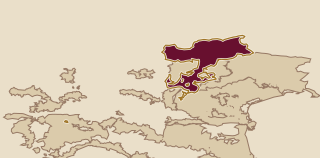
Mezzacorona sits in the town of Mezzocorona in Trentino, the alpine wine region tucked into the Adige Valley in northeastern Italy. It is a cooperative, founded in 1904, and its member growers now farm 2,800 hectares across the Trentino DOC. That holding represents more than a quarter of the appellation's total vineyard area, which means a single Mezzacorona bottle can draw on fruit from a significant slice of one of Italy's most geographically distinct wine regions.
The cooperative's commercial anchor is Pinot Grigio. Within that grape, Mezzacorona runs a clear tier system from valley-floor fruit to protected cliffside parcels near the village itself. The cooperative also operates Rotari, a Trentodoc sparkling brand produced by the traditional method.
Place and vineyards
Where the wines begin
Trentino is bounded by the Dolomites to the north and east and funnels southward through the Adige Valley. The combination of mountain altitude, strong diurnal temperature swings and river-corridor drainage gives the region's whites a reliable acid line and aromatic definition that broader northeastern Italian appellations often lack. The Trentino DOC covers a large and varied landscape: valley floors, terraced hillsides, and sheltered cliff-facing slopes each produce fruit with different weight and concentration.
Mezzocorona sits near the northern end of the Adige Valley, where the valley narrows and cliff faces on the eastern side catch sun through the afternoon while the rock shelters vines from cold alpine air. It is from these cliffside positions near the village that Mezzacorona draws the fruit for its upper-tier Pinot Grigio.
In the cellar
Vineyards and cellar
Mezzacorona's scale means the cooperative can route parcels selectively through different production paths. Valley floor fruit, with its higher yields and softer acid, goes into everyday Pinot Grigio made in stainless steel to preserve freshness and primary fruit. The cliffside vineyards near Mezzocorona village are the strategic reserve: the site's steeper angle and thinner soils produce more concentrated grapes, and that concentration justifies a different cellar treatment.
For the Castel Firmian Riserva Pinot Grigio, 60 percent of the wine spends time in small oak barrels during maturation. Oak at that proportion adds body and a slight roundness to the mid-palate without overwhelming Pinot Grigio's inherent fruit character, provided the underlying fruit has enough weight to carry it. The remaining 40 percent, presumably held in tank or neutral vessel, preserves the grape's freshness and keeps the wine from tipping into a heavily oaked register. Rotari's wines follow the traditional method: secondary fermentation in bottle, extended lees contact, and disgorgement before release.
Wines to know
The range in view
Mezzacorona's range is anchored in Pinot Grigio across two principal tiers. Entry-level bottles draw on the cooperative's broad Trentino DOC holdings and are built for accessibility: light-bodied, dry, with the clean stone-fruit and citrus character that made Trentino Pinot Grigio a staple on export markets. They are straightforward and consistent, the kind of wine that performs reliably across a wide range of occasions.
The Castel Firmian tier steps up in concentration and complexity. The cliffside source adds a more defined fruit profile, and the Castel Firmian Riserva Pinot Grigio introduces oak to the equation. At 60 percent barrel-matured, the Riserva carries a fuller mid-palate, a slightly rounded texture, and a longer finish than the tank-only styles below it. The oak is a deliberate textural decision, not a flavour statement: the wine remains dry, and Pinot Grigio's characteristic pale colour and stone-fruit aromas are still the main event.