
Why it matters
The producer
MGM Mondo del Vino is a large-scale Italian wine merchant and producer based in Priocca, in the Cuneo province of Piedmont. The name is not a place or a family estate: it is an acronym formed from the surnames of three oenologists who founded the company together on 5 April 1991. Alfeo Martini, Roger Gabb and Christoph Mack built a business focused on sourcing, tailoring and marketing Italian wines for export, principally to Britain and Germany. They did not own vineyards or a winery. For the first nine years, they operated as buyers and merchants, moving between third-party production facilities while they learned which grape varieties, appellations and styles their markets wanted.
MGM is not an estate: it does not farm its own land. Grapes arrive through direct agreements with producer cooperatives and private companies across its sourcing regions. The Priocca facility remains its largest production centre.
Place and vineyards
Where the wines begin
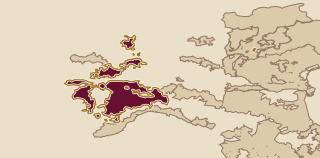
Priocca sits in the Cuneo province, in the southern part of Piedmont, the large northern Italian region bordered by the Alps to the north and west and the Apennines to the south. Piedmont is home to Barolo, Barbaresco, Barbera d'Asti and a dense network of DOC and DOCG appellations. MGM's Piedmontese output, which represents roughly 25% of its total production, draws on the Piemonte DOC, a broad appellation that covers Barbera grown across a wide zone of the region without village-level restriction. This is not a single-hillside address: it is a regional designation built for accessible, early-drinking reds.
In the cellar
Vineyards and cellar
MGM selects grapes through direct agreements with cooperatives and private growers, which means the quality of incoming fruit depends on the terms those agreements set and the monitoring the production team applies before and during harvest. The oenologist and biologist team at Priocca handles vinification, maturation, bottling and quality control.
For the Angelo Montepulciano d'Abruzzo in its current form, maturation takes place in stainless steel tanks, which preserves the grape's fresh dark fruit and avoids oak overlay. An older vintage of the same wine used six months in oak barrels after temperature-controlled fermentation, producing a more rounded, wood-influenced profile. The current stainless-steel approach keeps the wine direct: dark cherry, plum and dried herbs with soft tannins and a clean finish. The Riva Leone Barbera Piemonte DOC follows a similar everyday-drinking philosophy, with Barbera's naturally high acidity carrying the wine's freshness. The Sonovino blend from Puglia uses Primitivo's ripeness as its base, cut with Negroamaro for herbal lift and aromatic breadth.
Wines to know
The range in view
MGM's range operates through three branded labels, each tied to a different Italian region and grape variety.
Riva Leone covers the Piedmontese output, with Barbera Piemonte DOC as its anchor wine. Barbera is a naturally high-acid, low-tannin red grape that produces wines with dark cherry fruit, a soft body and enough freshness to drink young. The Piemonte DOC designation signals a regional rather than village-specific origin: broad, accessible, without a village designation such as a Barbera d'Asti or Barbera d'Alba label.
A useful way in
A bottle to begin with
Angelo Montepulciano d'Abruzzo is the clearest single bottle for understanding what MGM does at its most regionally specific. Montepulciano d'Abruzzo DOC is a well-established central Italian appellation, and the grape gives the wine a character that is genuinely regional: dark fruit, firm tannin, earthy depth, medium acidity. MGM vinifies it in stainless steel, keeping the profile clean and the fruit honest rather than layering in wood influence. The wine is full-bodied enough to hold up to food, soft-edged enough to drink without long cellaring, and priced for everyday use. One bottle tells you the grape, the region, and the production approach in a single pour.