
Why it matters
The producer
Michele Chiarlo started with no land. In 1958, two years after founding his winery at Calamandrana in the Asti hills, he bought grapes and bottled a Barolo. It was the first move in a decades-long project to acquire the vineyards behind the wine.
Today the house holds named parcels across the four appellations that define Piedmontese winemaking: Barolo, Barbaresco, Nizza and Gavi. Sons Alberto and Stefano now run the business, Alberto directing global sales and marketing while Stefano makes the wine. The policy their father established holds: no international varieties, no blending. Every bottle carries a single indigenous grape, grown in a named Piedmontese place.
Place and vineyards
Where the wines begin
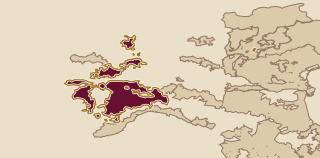
Piedmont wraps around Turin in the northwest corner of Italy, sheltered by the Alps to the north and the Apennines to the south. The Langhe hills at the heart of the region are where Nebbiolo produces Barolo and Barbaresco, the two appellations that anchor Italian wine at the serious end of the market. Barolo, a DOCG in the southwestern Langhe, demands a minimum of two years in oak and five total for Riserva bottlings; the wines age for decades in the right vintages. Barbaresco, on the eastern side of Alba, is lighter and earlier to open, though no less serious in ambition.
The spread means the house sells across every register of the regional table: sparkling Moscato at one end, age-worthy single-vineyard Barolo at the other.
In the cellar
Vineyards and cellar
Green harvesting at Cerequio reduced yields and extended ripening time, giving the Tortonian clay marl more opportunity to transfer its magnesium and manganese into the grapes. The logic applies across the Nebbiolo parcels: lower crop loads mean each cluster carries more concentrated pigment, tannin and aromatic material into the cellar.
In the cellar, the house uses soft pressing to protect fruit aromas, temperature-controlled fermentation to preserve fragrance, and rotating sprayers during maceration to wet the cap gently without the harshness of pumping over. Tortoniano, the appellation-level Barolo, macerates on its skins for 15 to 18 days in steel tanks under this gentle shower system. It then spends 18 to 24 months in average-sized oak casks before bottle refinement, reaching a minimum of three years total before release. Barbaresco Reyna, the access-level Nebbiolo from the Barbaresco zone, receives 9 to 12 months in medium and large casks before bottling.
Wines to know
The range in view
The range divides cleanly by grape and appellation. Nebbiolo occupies the top of the portfolio. Barolo Cerequio is the single-vineyard flagship: six hectares of Tortonian clay marl above La Morra, vinified with the house's gentle maceration method and aged in oak for a minimum of two years before bottle refinement. The wine develops floral violet and rose notes early, then dried cherry, tar and leather as it ages, with firm tannins that need time to resolve and a long, mineral finish. Barolo Cannubi, from the sandy marl of the named cru in the appellation, produces finer tannins and earlier aromatic development than Cerequio.
Tortoniano is the Barolo at appellation level, blended from Nebbiolo across the Barolo zone, with 15 to 18 days of skin contact and at least three years before release. It opens with red cherry and dried rose, with firm but not aggressive tannins and the characteristic bitter finish that Nebbiolo carries from this soil type.
A useful way in
A bottle to begin with
Barolo Tortoniano is the right first bottle. It is made from Nebbiolo sourced across the Barolo appellation, macerated for 15 to 18 days and aged for a minimum three years before release, so the wine carries the house's full technical signature without asking you to pay for a single-vineyard parcel. In the glass it opens with red cherry and dried rose, then broadens into tar and leather as it breathes. The tannins are firm and demand food, ideally braised beef or aged Piedmontese cheese. The acid line is long and clean.