
Why it matters
The producer
Michele Satta came to Bolgheri when the zone had no DOC and very little outside attention. He planted vineyards at Loc. Casone Ugolino 23 in Castagneto Carducci and was among the first producers to build an estate in the area before the appellation was formally established in 1984. He became a founding member of the Bolgheri DOC Consortium and spent the following decades arguing, planting, and bottling his way into its rules.
The estate's early history carries an extraordinary detail: Satta consulted for Ornellaia in the zone's formative years and planted many of its vineyards, including the parcel that became Masseto, now one of Italy's most expensive single-vineyard wines. He returned to his own land with a clear sense of what Bolgheri could hold beyond Bordeaux varieties.
Place and vineyards
Where the wines begin
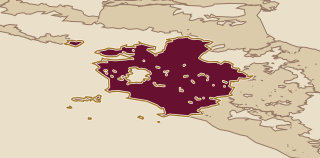
Bolgheri is a coastal DOC in the Maremma, the flat and forested stretch of southern Tuscany that runs down to the Tyrrhenian Sea. The appellation sits within the commune of Castagneto Carducci, behind a cypress-lined road that has become one of the most recognisable images in Italian wine. The maritime influence keeps temperatures moderate in summer and pushes harvest later than many inland Tuscan zones.
The DOC label covers two main styles: Bolgheri Bianco, for whites, and Bolgheri Rosso, for reds. The red wines may blend Cabernet Sauvignon, Merlot, Sangiovese, Syrah, and other approved varieties. Wines that fall outside the DOC blend rules or use non-approved varieties carry the broader Toscana IGT designation. Michele Satta's Syrah, grown from the estate's own plantings, appears under Toscana IGT for this reason.
In the cellar
Vineyards and cellar
The estate farms 23 hectares across its Castagneto Carducci holding. Biodynamic practices began in 2015; the organic certification from 2018 covers the full vineyard. Lower intervention farming at this scale, producing 150,000 bottles annually, requires consistent seasonal discipline across every parcel.
Costa di Giulia, the estate white, is the wine with the most confirmed cellar detail. Vermentino and Sauvignon Blanc are fermented separately: Vermentino goes into stainless steel; Sauvignon Blanc goes into concrete. The two varieties are kept apart through fermentation and then rested together on fine lees in steel for approximately six months before bottling.
Wines to know
The range in view
The range is built around three wines. Costa di Giulia is a single-estate white under the Bolgheri Bianco DOC: 60% Vermentino, 40% Sauvignon Blanc, fermented by variety and rested on fine lees.
The Bolgheri Rosso is the estate's DOC red, a blend of Cabernet Sauvignon, Merlot, Sangiovese, and Syrah.
A useful way in
A bottle to begin with
Start with Costa di Giulia. It is the wine that has no parallel in the Bolgheri appellation: a single-estate white from a zone built on red Bordeaux varieties, grown on the same coastal soils, fermented variety by variety, and rested on lees for six months. It is also the wine that carries the estate's longest history as a white wine producer in Bolgheri. Ordering it tells you what Satta chose to do in a zone that could have ignored white wine entirely.