
Why it matters
The producer
Mirco Mariotti makes natural sparkling wine on the coastal edge of Emilia-Romagna, from vineyards planted roughly 300 metres from the Adriatic Sea. The appellation is Bosco Eliceo DOC, a thin coastal strip in the province of Ferrara where sandy soils and salt air have kept alive grape varieties found almost nowhere else in Italy.
The wines are bottle-fermented from old ungrafted vines and named after card games played in local clubs. Fortana, a red grape tied almost entirely to this coastline, becomes Sèt e Mèz, a bone-dry rosé frizzante. Trebbiano Romagnolo and Malvasia di Candia Aromatica, blended at roughly 70 to 30, become Smarazen, a cloudy, undisgorged white frizzante raised in cement before its second fermentation in bottle.
Place and vineyards
Where the wines begin
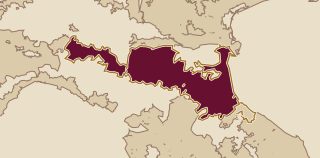
Bosco Eliceo DOC runs along the Adriatic coast south of the Po delta, between Comacchio and Ravenna. It is low, flat, and sandy, and the sea is close enough to smell. The appellation earned DOC status in 1989, driven in part by growers who recognised that the coastal geography preserved conditions found nowhere inland.
The proximity to the sea shapes everything about these wines. The climate is mild and the air saline. The sandy soil drains fast and holds heat through the night. Those same sands push root systems deep, down two metres in some plots, into the aquifer below. The Bosco Eliceo label on a bottle signals that the grapes came from this specific coastal strip, from varieties that survived here precisely because they were never planted widely enough to matter to the phylloxera that swept through European viticulture in the late nineteenth century.
In the cellar
Vineyards and cellar
The vineyards are farmed organically. For vine renewal, Mariotti uses propaggine, a layering technique in which a living cane from an existing vine is buried in the soil and encouraged to root. The new vine carries the genetic material of the parent rather than coming from a selected nursery clone. On a site with ungrafted centenarian vines, propaggine means the genetic continuity of the original coastal plantings moves forward plant by plant.
In the cellar, Smarazen is raised in cement tanks before undergoing a second fermentation in bottle for around 60 days. The wine is not disgorged. Yeast sediment stays in the bottle, giving the wine its cloudy appearance and a bready, autolytic quality alongside the dry herbaceous aromatics from the Malvasia. Sèt e Mèz follows the same bottle-fermentation path from Fortana. Neither wine goes near an autoclave.
Wines to know
The range in view
The range at Mariotti covers seven bottles: Sèt e Mèz, Surlìe, Smarazen, Uva d'Oro, Centro, Lè Turnè, and Stella Maris. Every name comes from a card game played in the Ferrara area. The naming connects the wines to local social life rather than to appellations or vineyards.
Sèt e Mèz is the red wine in the range, made from Fortana as a dry rosé frizzante. Fortana is a thin-skinned red grape with tart cherry and red plum on the nose, a light copper-pink colour, and a palate that is dry, saline, and fresh, with light tannin from the grape skin contact during fermentation.
A useful way in
A bottle to begin with
Start with Sèt e Mèz. It is made from Fortana, a red grape grown almost exclusively in Bosco Eliceo and almost nowhere else in Italy. Mariotti ferments it as a rosé frizzante in bottle, without an autoclave, so the fizz is fine and the palate is dry from start to finish. Tart cherry, a saline mineral edge, fresh acidity, and the lightest grip of tannin: the wine is small in alcohol, honest about its origins, and impossible to confuse with anything made inland. One glass explains the coastal site, the local grape, and the ancestral method all at once.