
Why it matters
The producer
Montalbera is the Monferrato estate most closely identified with Ruchè, an aromatic red grape that came within a generation of disappearing entirely. The Morando family has farmed the hills around Castagnole Monferrato across multiple generations; in the mid-1980s they made a deliberate bet, buying neighbouring land and planting it predominantly with Ruchè at a moment when the variety had no DOCG, limited commercial demand, and a reputation built mostly on the efforts of one parish priest.
That decision shaped everything that followed. Montalbera now farms 115 hectares spread across six hills at Castagnole Monferrato in Monferrato, with a separate 15-hectare Langhe property at 408 metres in Castiglione Tinella. The two zones give the estate two distinct identities: Monferrato is where Ruchè, Barbera d'Asti, Grignolino d'Asti, Monferrato Nebbiolo, and Viognier grow; the Langhe plot is planted solely to Moscato d'Asti and Barbera. Every bottle in the range is vegan, with no animal-origin inputs at any stage of production or bottling.
Place and vineyards
Where the wines begin
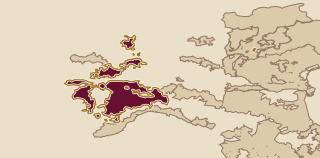
Castagnole Monferrato is a commune in the Asti province, sitting in the Monferrato hills between the Tanaro and Po rivers. The territory is hilly rather than dramatically alpine, with clay and calcareous soils suited to aromatic varieties that need warmth to ripen but enough elevation to hold acidity. Six hills surround a central valley where Piedmontese hazelnuts are grown; the vineyards occupy the hillsides above.
Ruchè di Castagnole Monferrato DOCG covers a small cluster of communes, and Castagnole Monferrato is its centre. The DOCG limits production to this compact zone, which means Montalbera's 115-hectare Monferrato holding occupies a significant share of the appellation's productive land. Bottles labelled Ruchè di Castagnole Monferrato must carry that place name; the appellation designation on the label is the clearest signal that a wine comes from this specific grape and this specific hillside geography.
In the cellar
Vineyards and cellar
All vineyard work at Castagnole Monferrato is manual, from pruning through harvest. The Guyot trellis system keeps yields controlled and the fruit accessible for selective picking. Vines aged between 7 and 30 years are at varying stages of concentration: younger vines produce more generous, immediately aromatic fruit; older vines give tighter, more concentrated material.
In the cellar, Montalbera applies different treatments to different varieties rather than a uniform house style. Stainless steel is used for wines where primary fruit and aromatic freshness are the goal, including Calypsos and the entry-level Ruchè. Wood ageing is reserved for wines that carry enough concentration to absorb it without losing their varietal character. Withering, which concentrates sugar and flavour by drying harvested grapes before pressing or fermentation, is used selectively to build body and depth in certain cuvées. Overripeness is also deployed as a separate tool where site conditions and vintage allow late-harvest character without full withering. No animal-origin fining agents or processing aids are used at any stage.
Wines to know
The range in view
Ruchè di Castagnole Monferrato DOCG anchors the range. Laccento is the core bottling: a red wine from Ruchè with rose petal and violet aromatics on the nose, ripe cherry and dark berry fruit in the mouth, moderately firm tannin from the variety's thin skins, and a rounded texture. Il Fondatore is the Riserva, produced in a limited run; it draws on older vine fruit and extended ageing to build a denser, more structured version of the same aromatic profile, with greater depth on the mid-palate and longer ageing capacity.
Calypsos is a varietal Viognier under Piemonte DOC, drawing fruit from both Castagnole Monferrato in Monferrato and Castiglione Tinella in the Langhe. Viognier in Piedmont is unusual; the variety is associated with the northern Rhône and brings stone fruit character, apricot and white peach aromatics, low to moderate natural acidity, and a full, slightly oily texture when ripe. Calypsos is vinified by traditional white wine process with gentle pressing and matures entirely in stainless steel, which keeps the variety's fruit vivid and the texture clean rather than unctuous.
A useful way in
A bottle to begin with
Start with Laccento, Ruchè di Castagnole Monferrato DOCG. It is the wine that explains what the estate is and what the appellation does. Ruchè is not Barbera and not Nebbiolo; it is aromatic in the way a northern Rhône red is aromatic, with rose and violet on the nose and dark fruit underneath, but the tannin is rounder and the body is lighter than either of Piedmont's more famous red varieties. Laccento is made in stainless steel with no oak, which means every aromatic quality in the glass comes from the grape and the site, not from cask treatment.