
Why it matters
The producer
Carlo Cottini planted vines alongside cherry, plum, and apricot trees in Valpolicella in 1925. Wine was one crop among several. His son Raffaello changed that: in the 1950s Raffaello specialised in winemaking and built a cellar at Fumane, in the Valpolicella heartland. In 1965 the family moved its cellar to Caprino Veronese, a town at the foot of Monte Baldo in what independent sources describe as the Morainic Amphitheater of Rivoli Veronese, a landscape shaped by ancient glacial deposits on the northern fringe of the Veneto plain.
The estate continued in that form until 1998, when Diego Cottini, Carlo's grandson and the third generation, chose a different direction. In 1998, Diego Cottini created Montezovo. Two years later he went further, acquiring land in Eastern Valpolicella in deliberate search of higher altitude. A decade after that, in 2010, he acquired 30 hectares near Sirmione on the southern shore of Lake Garda, founding the Le Civaie estate for Lugana DOC production. Diego now works alongside his wife Annalberta and their sons Michele and Mattia, the fourth generation.
Place and vineyards
Where the wines begin
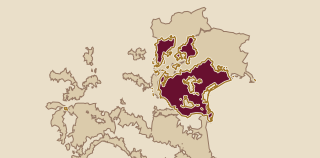
Monte Zovo operates across two geographically separate zones. The Valpolicella properties sit in the hills northeast of Verona. The main cellar at Caprino Veronese anchors the operation, while the Marnebianche estate in Eastern Valpolicella occupies the ridgeline between the Illasi and Mezzane valleys, at the edge of the Monti Lessini national park. These are hillside parcels with altitude and ventilation, conditions suited to Corvina, the dominant red grape of Valpolicella, and to the appassimento drying process that produces Amarone and Recioto.
The Le Civaie estate near Sirmione is a different world. The southern shore of Lake Garda is limestone and glacial moraine, flat rather than hilly, and the grape there is Turbiana, the local white variety also called Trebbiano di Lugana. The lake moderates temperature, extending the growing season and keeping acidity in the grape. The consequence on the label is a white wine appellation, Lugana DOC, with none of the dried-grape concentration that defines the Valpolicella reds.
In the cellar
Vineyards and cellar
Monte Zovo farms its own parcels across all three estates and manages each stage from vine to bottle without outside sourcing. The estate applies innovative, sustainable agronomic practices to protect biodiversity and minimize synthetic inputs, a commitment the estate formalises through its Biodiversity Friend certification. The cellar at Caprino Veronese is built into the hillside, using the slope gradient to move fruit downward through reception, fermentation, and ageing in sequence, avoiding the need for mechanical pumping at each transfer. Rainwater is harvested and packaging is chosen for lower environmental impact.
At Marnebianche, the drying facility at 1,650 feet is the production detail that most directly shapes the wine. Appassimento, the controlled drying of harvested grapes on wooden racks over weeks or months, reduces water content and concentrates sugars and flavour compounds before fermentation. Corvina, the main grape, dries well at this altitude, where cool temperatures and good air movement prevent mould and allow slow, even dehydration. The result feeds the Amarone tier of the range.
Wines to know
The range in view
The range divides by geography and method. From the Valpolicella estates, the appellation ladder runs from Valpolicella DOC at the base through Valpolicella Superiore, then Ripasso, and up to Amarone della Valpolicella DOCG and Recioto della Valpolicella at the dried-grape summit. Corvina leads each blend, as it does across Valpolicella. At the base level, the wine is fresh, light-bodied, and high in acidity, with the tart cherry character Corvina delivers when fermented without drying. Ripasso wines add body and dried-fruit depth by refermentation over Amarone lees or dried grape skins. Amarone carries the full weight of appassimento: fermented dry from grapes that have lost a significant proportion of their water weight, it produces a full-bodied red with concentrated fruit, firm tannin, and the warmth of elevated alcohol. Recioto is the sweet counterpart, fermented to retain residual sugar.
A useful way in
A bottle to begin with
Start with the Lugana DOC from Le Civaie. It is one grape, one zone, one appellation, and it shows how clearly the geography of this estate divides between its two wine worlds. Turbiana grown on the calcareous ground near Sirmione makes a dry white with firm acidity, pale citrus fruit, and a mineral, slightly savoury finish. It is not a complex wine, but it is an honest one, and it demonstrates something specific about Monte Zovo: that the estate built its range around geographic logic rather than stylistic convenience. The 30 hectares Diego acquired near Sirmione in 2010 belong to Lake Garda, not to Valpolicella, and the wine reflects exactly that separation.