
Why it matters
The producer
Fabio Chiarelotto holds a doctorate in history. He bought Montepeloso in 1998, had the estate running under his direction by 1999, and has spent the years since working out what a serious red wine looks like in one of Tuscany's warmest corners.
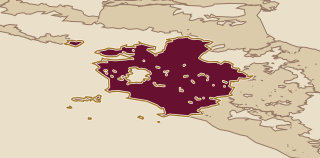
The estate covers 30 hectares in the Maremma, inland from the Tyrrhenian coast near the medieval town of Suvereto, within the Val di Cornia DOCG. Fourteen of those hectares carry vines, planted in seven varieties spread across terraced and rolling ground between 50 and 200 metres elevation. The principal grapes are Montepulciano, Sangiovese and Cabernet Sauvignon, with Alicante, Marselan, Malvasia Nera and Alicante Bouschet filling out the remaining parcels.
Place and vineyards
Where the wines begin
The Maremma is the long coastal strip of southern Tuscany running down to the Lazio border. Montepeloso sits in the inland part, close to Suvereto, where the Val di Cornia appellation covers both red and white wines but earns its reputation almost entirely from reds. Val di Cornia received DOC status in 1989 and DOCG status in 2011.
The climate is Mediterranean and warm: long summers, low rainfall, and the moderating influence of the sea at a remove. For a producer whose stated ambition is something that feels refined rather than heavy, that warmth is the central problem the vineyard and cellar have to solve. The elevation range of 50 to 200 metres across the estate's terraced and rolling slopes gives some variation in temperature and harvest timing, and the altitude at the upper parcels provides cooler nights that slow ripening and help keep acidity in the fruit.
In the cellar
Vineyards and cellar
Fourteen hectares carry seven varieties in proportions that put Montepulciano and Sangiovese clearly in front. Montepulciano, the dominant grape at 32 percent, brings dark fruit, firm colour and a tannic grip that loosens with time in the bottle. Sangiovese, at 28 percent, supplies acidity and the bright cherry and dried herb character that keeps the wines from reading as southern and heavy. Cabernet Sauvignon adds body and extends ageing potential. The smaller parcels of Alicante, Marselan, Malvasia Nera and Alicante Bouschet contribute detail and complexity to the blends without driving any single wine.
In the cellar, macerations are kept relatively short. That choice matters in a warm-climate estate: longer macerations in high-sugar fruit extract tannin and pigment aggressively, and Montepeloso's approach deliberately pulls back from that point. Natural yeasts drive fermentation slowly, and the wine goes to bottle unfined and unfiltered. The result across the range is wines with dark colour and concentrated fruit but a suppleness in the tannin that lets them be approached earlier than their depth suggests.
Wines to know
The range in view
A Quo is the estate's entry wine, introduced with the 2008 vintage. The blend draws on Montepulciano, Sangiovese and Cabernet Sauvignon as its core, with Marselan and Alicante Bouschet in smaller proportions. It carries the estate's no-filtration, natural-yeast approach at a price point well below the two wines above it. The fruit is dark, the body medium-full, and the wine is built to be approachable within a few years of release without losing grip.
Eneo sits in the middle of the range as a Sangiovese-led red. The supporting varieties have shifted over time and include Malvasia Nera, Cabernet Sauvignon and other local grapes. It is more concentrated than A Quo and rewards a few more years in the cellar, with Sangiovese's characteristic acidity keeping the wine fresh through its mid-palate despite the warmth of the growing season.
A useful way in
A bottle to begin with
A Quo is the right first bottle. It carries every core decision Montepeloso makes: natural-yeast fermentation, no filtration, Montepulciano and Sangiovese leading the blend, short macerations holding the extraction in check. In the glass it opens with dark cherry and blackberry, a firm but not aggressive tannin, and the kind of acidity that keeps a warm-climate red from feeling flat. The body is full but not heavy. It is approachable within a year or two of release and does not require the commitment that Eneo or Nardo asks for, either in patience or price. Start here: it answers the question of whether Montepeloso's approach suits a particular palate before moving to the wines above it.