
Why it matters
The producer
The farm began in 1692 as De Wolwedans, established by German settler Willem Barend Lubbe on land granted by Simon van der Stel. It later became Neethling’s Hof when Johannes Henoch Neethling took sole ownership. Today, Neethlingshof remains an estate producer: its vegan-certified wines are made on the property, so vineyard decisions and cellar work stay closely connected.
Iwayini, the South African subsidiary of Grands Chais de France, bought Neethlingshof in 2022. Mika Engelbrecht became head winemaker in 2023 after studying under De Wet Viljoen, joining an estate whose white wines draw on both maritime cooling and a wide choice of vineyard sites.
Place and vineyards
Where the wines begin
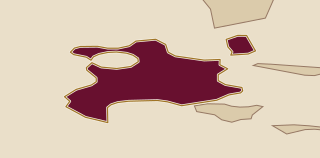
Stellenbosch sits in the Coastal Region, where sea air can reach inland vineyards. At Neethlingshof, afternoon winds from False Bay moderate daytime heat, slowing ripening in the grapes. The result is useful for white varieties: fruit can build flavour while retaining the acidity that keeps a broad blend such as The Six Flowers dry and lively rather than heavy.
The estate’s position between the Bottelary Hills and Papegaaiberg Mountain also makes its setting more varied than a single flat vineyard block. Bottles can therefore be built from grapes selected for particular corners of the farm instead of forcing every variety into the same conditions.
In the cellar
Vineyards and cellar
Cover crops and canopy management are used in the vineyards to reduce chemical inputs, while drip irrigation directs water to the vines. The estate also recycles cellar water for vineyard irrigation and holds WWF Conservation Champion status. These choices keep soil cover and water management part of the growing season rather than separate from it.
For the documented 2016 Six Flowers, each component wine aged separately for eight months in new 300-litre French oak barrels before blending. Separate ageing allowed the cellar to keep the grapes distinct until assembly: Chenin Blanc and Chardonnay could retain their weight, while Sauvignon Blanc, Riesling, Viognier and Gewürztraminer could contribute fruit, floral notes and spice before the final blend was set.
Wines to know
The range in view
Neethlingshof’s range is organised as the Estate range, the Short Story Collection and the 1802 Collection. The Short Story wines connect estate history and conservation themes, and The Six Flowers sits at its reserve level. This is not a single-grape statement: it is a layered white blend designed from six varieties with different roles.
In the documented 2014 release, Chenin Blanc and Chardonnay each made up 31% of the blend, followed by 22% Sauvignon Blanc, 5.5% Viognier, 5.5% Gewürztraminer and 5% Riesling. The large Chenin and Chardonnay share gives the wine body and ripe yellow-fruit weight; the smaller aromatic components bring floral perfume, citrus and spice. The 2016 release shows the same six-variety approach, with oak-aged components adding a fuller texture and spice.
A useful way in
A bottle to begin with
Start with Neethlingshof The Six Flowers 2014, a 13.5% Stellenbosch white listed in Sweden and made from 31% Chenin Blanc, 31% Chardonnay, 22% Sauvignon Blanc, 5.5% Viognier, 5.5% Gewürztraminer and 5% Riesling. It puts the estate’s site selection, sea-cooled ripening and history-linked label into one glass. Expect ripe apple, apricot and yellow fruit, a lightly smoky oak note, dense texture, balanced acidity and a dry finish.