
Why it matters
The producer
Andrea Mosca left a career as an architect and, with Giovanna Pepe Diaz, bought land in Brusnengo in 2010 in a zone of northern Piemonte that most Italian wine buyers could not place on a map. They named the estate NOAH after their son, Francesco Noah, and made their first wines from the 2011 harvest. Fifteen years on, NOAH farms five hectares across Bramaterra, Lessona, and Coste della Sesia, with a further 1.5 hectares of Bramaterra vineyard in Curino under management since winter 2022. Annual output is approximately 15,000 bottles. Andrea Mosca makes the wine; Maurizio Forgia works as oenologist.
The vineyards carry names: Mesola and Forte in Brusnengo, Vigna del Monte in Lessona, Salero in the district where the family has lived since 2016. The bottles carry those names too. NOAH is a small estate that keeps its geography visible.
Place and vineyards
Where the wines begin
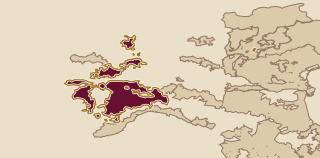
Alto Piemonte sits in the foothills of the Alps in the northern reaches of Piemonte, well above the Langhe where Barolo and Barbaresco are made. The climate is cooler and wetter, the topography more irregular, and the zone has spent decades operating at the edge of mainstream Italian wine attention. That obscurity is changing, slowly, as Nebbiolo from volcanic and glacial soils draws buyers looking for something leaner than the Langhe.
The Brusnengo vineyards in the Mesola and Forte sectors sit on the red volcanic porphyry that defines Bramaterra. Bramaterra's defining soil is red volcanic porphyry. It drains well and forces vines to work for water, which tends to concentrate flavour without adding warmth. The Vigna del Monte site in Lessona occupies different ground: lighter, with more sand, and the wines it produces reflect that in texture and body weight.
In the cellar
Vineyards and cellar
All three grapes, Nebbiolo, Vespolina, and Croatina, grow across the Brusnengo and Lessona parcels. Nebbiolo carries the heaviest weight in every wine; in Bramaterra Salero it accounts for approximately 90 percent of the blend, which translates to deeper colour, firmer tannin, and a more muscular body than a wine with a larger share of the lighter-framed Croatina or the floral Vespolina.
Wines to know
The range in view
The range follows the three appellations. RossoNoah is the Coste della Sesia bottling: Nebbiolo, Vespolina, and Croatina fermented in open vessels and aged in the estate's combination of Slavonian casks and old barriques. It is the lightest wine in the range, with red-cherry fruit, dried violet, a lean mineral edge, and a finish that carries more freshness than weight. It is the bottle to open earliest.
Bramaterra Salero is the estate's core wine. The blend is approximately 90 percent Nebbiolo from the Mesola and Forte sectors in Brusnengo, with Vespolina and Croatina completing it. It ages longer in the same neutral wood, and the Nebbiolo proportion gives it a darker, more tannic frame: black cherry, iron, dried herbs, and a firm finish that asks for several years in bottle. The Salero designation refers to the district of Brusnengo where the family lives, and the wine carries that specificity in its character as well as its name.
A useful way in
A bottle to begin with
Bramaterra Salero is the first bottle. It is a Nebbiolo-dominant red from the Mesola and Forte sectors in Brusnengo, the estate's oldest and most fully expressed Bramaterra parcels, aged in large neutral Slavonian oak casks and old barriques that have long since given up any extractive character. The wine has dark fruit, firm dry tannin, and that iron-mineral grip from the red porphyry soil underneath. It is not immediately easy: the tannin in younger vintages takes time to settle. But it is clearly the bottle that shows what NOAH is doing with this land, and why this small forgotten appellation in the Biella hills is worth the attention it is receiving.