
Why it matters
The producer
ODE began operating in December 2021 in a building first constructed in 1902, keeping original winery machinery in use rather than treating the old cellar as decoration. The result is a Tejo project where stainless steel, used oak and clay amphorae each have a defined role: Quarteto is co-fermented in steel and partly matured in barrel, while Amphora takes Alicante Bouschet through a year in clay.
Maria Vicente comes from Alentejo and has worked more than twenty harvests. Her work as a Madeira and Port educator, WSET teacher and competition judge sits alongside a cellar method that uses native fermentation, oak and filtration selectively, according to the winery. Those choices leave room for different wine shapes rather than applying one house texture to every bottle.
Place and vineyards
Where the wines begin
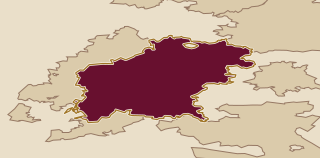
ODE sits in Vila Chã de Ourique, in Cartaxo, beside the Tagus River in Tejo. The estate combines a winery with a farm and rural-living project, so vines are part of a larger working property rather than an isolated block. The labels draw from plantings including Arinto, Fernão Pires, Alvarinho, Touriga Nacional, Semillon, Alicante Bouschet and Cabernet Sauvignon; that mix opens a path from fresh white grapes to dark-skinned reds.
Limestone lies beneath ODE’s vineyards. Above it, the farm is managed organically and regeneratively, with vegetables, animals and vines integrated into the property. This is a farming setting with several crops and living systems in view, while the wines themselves show the cellar’s separate decisions: steel for fruit-led fermentation, old oak for a broader red texture, and amphora for Alicante Bouschet.
In the cellar
Vineyards and cellar
ODE describes its approach as minimal intervention, but the useful detail is its selectivity. Native fermentation is used where the fruit permits it; oak and filtration are used when they serve the wine. For Quarteto 2023, four varieties were co-fermented in stainless steel, then passed through a long, slow malolactic fermentation. Half the blend spent ten months in used 500-litre French-oak barrels, a choice that adds cedar and breadth without making new-oak flavour the dominant note.
ODE Amphora 2022 takes a more singular route. It is 100% Alicante Bouschet, fermented and aged for twelve months in traditional clay amphorae. Clay is not presented as a flavouring agent here; its role is part of a wine whose documented profile centres on dark fruit, spice, texture and active acidity.
Wines to know
The range in view
The documented range includes white wines based on grapes such as Arinto and Viognier, alongside two clearly distinct reds. Quarteto 2023 is the blended, co-fermented wine: medium-bodied, savoury and built around black fruit, earth and truffle, with soft but drying tannin. Independent notes add blackberry, blueberry, cedar, tobacco and sandy tannin, with above-medium acidity and a fresh, slightly short finish.
Amphora 2022 narrows the focus to Alicante Bouschet and clay. The wine is described as vibrant, powerful and textured, with the grape’s dark-fruited register carried through an amphora élevage rather than a barrel programme. These are not interchangeable reds: Quarteto brings several varieties and used oak into one frame, while Amphora places one dark-skinned grape against a clay vessel.
A useful way in
A bottle to begin with
Start with ODE Amphora 2022. It is 100% Alicante Bouschet, fermented and aged for twelve months in traditional clay amphorae, so both the grape and the vessel are explicit. Expect dark fruit, red berries, spice, earth and a textured palate cut by mineral acidity. It introduces ODE through a single clear decision: take a deeply coloured Tejo red grape and let clay, rather than oak, shape its development.