
Why it matters
The producer
Ornellaia planted Bordeaux varieties on the Tuscan coast before Italian wine law gave them anywhere legal to go. Marchese Lodovico Antinori founded the estate in 1981 on a strip of land between the medieval village of Bolgheri and the Tyrrhenian Sea, and brought in André Tchelistcheff, the California consultant who had shaped a generation of Napa winemakers, to advise on the project. The first Ornellaia vintage came in 1985, and the wine went to market labelled as a humble IGT, a table wine classification, because Bolgheri had no category yet for a serious Cabernet Sauvignon blend.
The Frescobaldi family now owns Ornellaia, with Marchese Ferdinando Frescobaldi as president and Marco Balsimelli as technical director. The estate's approach has not changed in its essentials: dozens of individual vineyard parcels, farmed and vinified separately, blended into a final wine shortly before bottling.
Place and vineyards
Where the wines begin
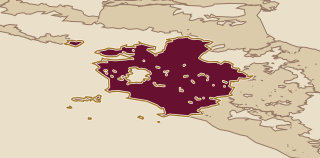
Bolgheri is a DOC appellation on the Tuscan coast, in the Maremma lowlands south of Livorno, a long way from Chianti and Barolo country. The coastal climate is mild and maritime: Mediterranean warmth softened by afternoon sea breezes that slow ripening and hold acidity in the grapes through the final weeks before harvest.
In the early 1970s and 1980s, a small group of estates in Bolgheri began planting Cabernet Sauvignon and Merlot rather than the Sangiovese that Italian wine law required for almost every classified wine in Tuscany. The wines they made were remarkable and expensive. Because they fell outside the denominazione rules, they were classified IGT, the lowest legal tier. That classification mattered not at all to the international market. The success of Bolgheri IGTs rewrote how buyers and critics read Italian wine.
In the cellar
Vineyards and cellar
Ornellaia's vineyards are divided into dozens of individual parcels, each with its own soil type, aspect and vine age. The parcels are farmed separately and vinified separately after harvest. All lots remain distinct until shortly before bottling, when the final blend is assembled. The process concentrates each growing season's selection into one decision made with complete information: every parcel tasted as a finished wine before the blend is locked.
The flagship Ornellaia is aged for 18 months in oak barrels, 65 percent of which are new. New oak at that percentage leaves a mark: it integrates with Cabernet Sauvignon's tannin during the ageing period and adds depth without obscuring the fruit. The choice of new oak proportion is deliberate, and it shapes the weight and ageing arc of the wine.
Wines to know
The range in view
The range runs from Le Volte dell'Ornellaia at the approachable end through Le Serre Nuove dell'Ornellaia and up to the flagship Ornellaia Bolgheri Superiore, with Ornellaia Bianco as a white wine made from coastal parcels.
Le Volte is the entry label: a blend made for early drinking, with soft tannin and fruit-forward character. It draws on the same vineyard base but is built for the table within a few years of vintage.
A useful way in
A bottle to begin with
Ornellaia Bolgheri Superiore is the bottle. It is the flagship red blend: Cabernet Sauvignon dominant, with Merlot, Cabernet Franc and Petit Verdot, aged 18 months in barrel, 65 percent new oak, assembled from the best-performing parcels of the vintage. On the palate it delivers dark fruit, cedar, firm coastal tannin and the kind of mid-palate density that needs three to five years from vintage to fully open. The acidity from the maritime growing season lifts the finish clean. This bottle contains everything the estate is built to produce: the parcel selection philosophy, the Bordeaux variety blend, the Bolgheri coastal environment, and the cellar work that holds it together. Start here.