
Why it matters
The producer
Pellerin is a négociant house: its range is built around wines from several places rather than a single enclosed domaine. Its Beaujolais portfolio runs from Beaujolais and Beaujolais-Villages to Moulin-à-Vent, Brouilly, Côte-de-Brouilly, Chiroubles and Fleurie. That breadth puts the place name on the label to work; each cru names the origin of the wine, while the Pellerin name supplies the house and range behind it.
The house began as a Beaujolais business in 1912, then developed a range broad enough to carry both cru wines and Rhône reserves. One visible decision was the Wine and Art range, which paired each cru with a graphic creation. That treatment gave the bottle a visual signal tied to the cru name, while leaving the wine’s appellation visible as the central geographic fact. Another enduring name, Le Père La Grolle, links Pellerin’s merchant activity to a network of growers rather than to a single château.
Place and vineyards
Where the wines begin
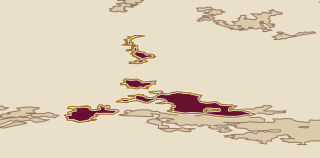
Quincié-en-Beaujolais places Pellerin in the northern Rhône-Alpes wine landscape, close to the appellations that shape much of its documented range. Beaujolais and Beaujolais-Villages sit alongside cru names such as Brouilly and Fleurie, so the label moves from broad regional red wine to more specific appellation wine. Beyond Beaujolais, the Joseph Pellerin Côtes-du-Rhône Reserve labels extend the range south into Rhône blends, including red and white formats.
Pellerin’s labels should not be reduced to one soil story. The practical consequence is to read each bottle by its appellation: Côte-de-Brouilly and Chiroubles are place names with their own boundaries, while a Beaujolais label works at the regional level.
In the cellar
Vineyards and cellar
Cellar detail is clearest when read bottle by bottle. Le Père La Grolle 2016 has its own recorded élevage and drinking window, so it should be treated as a finished Beaujolais release rather than a general description of every Pellerin red. For Joseph Pellerin Côtes-du-Rhône Reserve 2023, the bottled red has recorded oak maturation, while a separate red bag-in-box release is handled in steel tanks. Oak, steel, body, tannin and finish are therefore format-specific clues, not house-wide rules.
Wines to know
The range in view
The Beaujolais side of the range begins with Beaujolais and Beaujolais-Villages, then moves through named crus including Moulin-à-Vent, Brouilly, Côte-de-Brouilly, Chiroubles and Fleurie. Le Père La Grolle belongs to this Beaujolais world: its 2017 release received a silver medal at the 2018 Concours des Grands Vins du Beaujolais, while the 2016 release carries the fuller available tasting and élevage material.
The Rhône side is represented by Joseph Pellerin Côtes-du-Rhône Reserve. The 2023 red is documented with a grape blend, oak maturation and ageing potential; a steel-tank bag-in-box version has separately recorded production details. There is also a white Côtes-du-Rhône Reserve sold in a two-litre box. These are not interchangeable labels: colour, blend, vessel and handling change the fruit, body, tannin, acidity and finish to look for.
A useful way in
A bottle to begin with
Start with Le Père La Grolle 2016. In the glass, it offers the chance to focus on red-wine fruit, acidity, texture and finish without confusing a cru name with a single estate vineyard. Its label also opens directly onto Pellerin’s 1993 trademark story.