
Why it matters
The producer
Giuseppe Perlino started in 1905 in Castello D'Annone, a small town in the Province of Asti, with the intention of bringing the finest wines of the territory to wider markets. The enterprise grew into larger premises on the outskirts of Asti, and then, at the end of the 1990s, expanded again with a second production site at Montiglio Monferrato, fitted with wooden barrels and barriques for wine ageing. Today Perlino operates from its main Asti facility and the Montiglio Monferrato site, moving more than 130,000 hectolitres annually across its sparkling-wine and vermouth cellars. The house is now part of La Martiniquaise, a French spirits group.
Two things define Perlino clearly: its position at the centre of one of Piedmont's most productive sparkling-wine zones, and a vermouth recipe that has not changed in more than a century. Those two product lines sit in separate cellar worlds but share the same Asti address and the same founding logic: source the best from the territory, and keep the process stable.
Place and vineyards
Where the wines begin
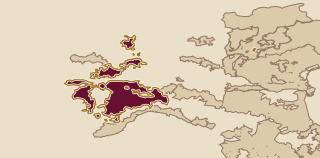
Asti sits in the southern Piedmont hills, between the Langhe to the south and the Monferrato to the north and east. The city is the natural hub of the Asti DOCG zone, a territory covering 9,700 hectares of vineyard across the provinces of Cuneo, Asti, and Alessandria, almost all of it planted to Moscato Bianco. The zone carries UNESCO World Heritage status, partly for the cultural landscape of the hillside vine rows but also for the deep tradition of Moscato-based sparkling wine that has made Asti one of Italy's most recognisable wine appellations internationally.
In the cellar
Vineyards and cellar
Perlino's sparkling wines are made by the Charmat method, known in Italy as the Martinotti method: secondary fermentation takes place in pressurised, sealed tanks rather than in individual bottles. Closed-vat fermentation at controlled temperature preserves the fresh aromatics of Moscato Bianco, and a long resting period in tank after fermentation adds body and complexity before bottling. The wine carries the grape's characteristic apricot, peach, and orange blossom aromas with a mousse that is fine rather than aggressive, and a sweetness that is kept lively by the variety's natural acidity.
The vermouth operation runs on a separate logic. Aromatic herbs and spices, more than 20 in the recipe, are macerated in alcohol for a minimum of 30 days. The hydro-alcoholic infusion extracts the botanical aromatics slowly, and the resulting liquid is then blended with wine, additional alcohol, and sugar to produce the final product. The recipe has been held fixed for more than a century. No post-blending barrel ageing is stated for any of the three vermouth styles.
Wines to know
The range in view
Perlino's range divides into two distinct product families that share an Asti origin but operate in entirely different categories.
The sparkling wines cover Asti DOCG and Prosecco DOC. The Asti DOCG bottles are Moscato Bianco-based, Charmat-method sparkling wines carrying the sweetness and aromatic character that define the appellation: low alcohol, gentle mousse, pronounced stone-fruit and flower aromas, and a palate that is sweet without being heavy because the grape's acidity provides lift. The Prosecco DOC is made from Glera, also by tank fermentation, with dosage that places it in the extra-dry style: slightly off-dry, with pear and green apple fruit and a clean, uncomplicated finish.
A useful way in
A bottle to begin with
Start with Vermouth Bianco. It is the bottle that runs closest to the founding recipe and shows most clearly what the house does technically: a minimum of 30 days of botanical maceration, more than 20 herbs, blended with wine and sugar to 140 grams per litre. The straw-yellow colour is pale and clean, the nose is intense, and the palate is sweet but held in check by the herbal backbone. Pour it over ice with a slice of orange, and the bitterness becomes more prominent as the temperature drops. It is an honest aperitivo, and it is the reason the house has kept the same formula for more than a century without revision.