
Why it matters
The producer
The Pinti family has farmed this corner of the Montalcino hills for four generations. They are agricultural people first: the estate covers 50 hectares, and only 8.5 of those hectares are planted to vine. The rest grows something else. Brunello is the commercial centre, but it sits inside a broader relationship with this specific piece of land in Siena province.
The vineyards divide clearly: 6 hectares committed to Brunello di Montalcino DOCG, 2 hectares to Rosso di Montalcino DOC, and 0.5 hectares to a small Sant'Antimo bottling. Annual production runs to 38,000 bottles of Brunello and 14,000 bottles of Rosso. The numbers suggest a mid-sized family operation working at a scale that allows hands-on management without industrial volume.
Place and vineyards
Where the wines begin
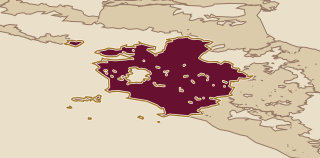
Montalcino is a hilltop town in the province of Siena, roughly 40 kilometres south of Siena city. The Brunello di Montalcino DOCG covers the entire commune, and every bottle must be made from Sangiovese grown within those boundaries. Locally, this Sangiovese clone is called Brunello, a name that distinguishes the Montalcino biotype from the same grape grown elsewhere in Tuscany under Chianti or Morellino designations.
Pian delle Querci sits at 250 metres elevation. At that altitude, the Montalcino climate is warm enough to ripen Sangiovese fully but cool enough at night to preserve the acidity that holds Brunello together through its long ageing. The clay soils at this address are dense and mineral-rich, retaining water into the dry summer months and slowing vine development in a way that concentrates fruit without forcing it.
In the cellar
Vineyards and cellar
The vineyards are trained to low spur-pruned cordons with short pruning. Low cordon training keeps the canopy close to the ground, where reflected heat from the soil aids ripening. Short pruning reduces the number of buds left after winter cutting, which limits the number of shoots and ultimately the number of bunches per vine. The consequence is lower yield and more extract per berry.
In the cellar, Brunello fermentation begins with medium-long skin maceration. During the early phase, pump-overs are frequent and described by the estate as especially intense. Pumping juice over the floating cap of skins extracts colour, tannin, and aroma compounds. Intense early pump-overs at Pian delle Querci produce a Brunello with deep colour and firm tannins from the outset.
Wines to know
The range in view
Brunello di Montalcino DOCG is made from Sangiovese grown on the estate's 6 hectares within the Montalcino commune. Annual production is 38,000 bottles. The wine is the result of medium-long maceration, indigenous yeast fermentation, and three years in new large Slavonian oak. The estate describes it as intense ruby with garnet reflections, clear, with ethereal and complex aromas and fruit that has integrated with wood over the ageing cycle. The tannins from intense early pump-overs give it the backbone required for extended bottle development. Brunello di Montalcino by regulation cannot be released before five years from harvest for standard bottlings.
Rosso di Montalcino DOC draws from 2 hectares and produces 14,000 bottles a year. It is made from the same Sangiovese grown in the same clay soils with the same fermentation approach, but it carries a shorter ageing requirement under DOC rules and is released younger. The Rosso is the way into the estate's vineyards and cellar before committing to the Brunello's price and drinking window.
A useful way in
A bottle to begin with
Start with the Brunello di Montalcino DOCG. It is 100 per cent Sangiovese from 250-metre clay parcels, fermented without added yeast, and aged three years in new 50-hectolitre Slavonian oak before ten months in bottle. The wine needs time after release: the firm tannins from intense early extraction and new wood are present and require either patience or food. Open it with a few hours of air, or plan to cellar it for several years after purchase. What you get is a classically built Montalcino Sangiovese with deep colour, dried-cherry and earth aromatics, concentrated mid-palate weight, and the long tannic finish that defines the appellation at its most traditional.