
Why it matters
The producer
Piero Busso's family has grown Nebbiolo in Neive since Guido Busso planted the first rows in Albesani in 1948. Three generations later, Piero and his son Pierguido farm all 10 hectares themselves, harvesting by hand into small crates and doing most vineyard work without outside help. The estate is small enough that the two men know every row.
The approach in cellar matches the approach in vineyard: long macerations, large neutral casks, no fining, no filtration. Nothing is rushed and nothing is added. What goes into the bottle is Nebbiolo from four named Barbaresco parcels, shaped by time and oak rather than by intervention. The family had farmed without herbicides or synthetic treatments for years before organic certification arrived with the 2019 harvest. Certification named a practice already in place.
Place and vineyards
Where the wines begin
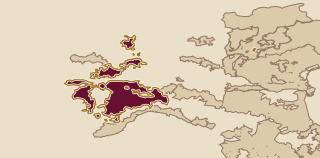
Barbaresco is a DOCG in the Langhe hills of southern Piedmont, built entirely around Nebbiolo grown across four communes: Barbaresco, Neive, Treiso, and San Rocco Seno d'Elvio. All four Busso crus carry the Barbaresco denomination, though they sit in two different communes. Three of them, Albesani, Mondino, and Gallina, are in Neive. The fourth, San Stunet, is in Treiso.
Neive is the largest of the four communes and occupies the eastern portion of the DOCG. Its soils are predominantly Helvetian calcareous marl: compact, alkaline ground that slows Nebbiolo's vigour and pushes the grape toward firm tannin, high acidity, and fruit that contracts before it opens. The MGA system, Barbaresco's formal single-vineyard classification, confirms the boundaries and status of named parcels. Gallina and San Stunet both carry MGA designation, placing them in a recognised tier of named sites with defined boundaries.
In the cellar
Vineyards and cellar
Piero and Pierguido harvest by hand into small crates, which limits oxidation and crushing before the grapes reach the cellar. Destemming comes before fermentation on indigenous yeasts in either temperature-controlled stainless-steel tanks or wooden tine fermenters, the choice depending on the cru and vintage. Maceration is long: weeks rather than days, sometimes extending well beyond a month for certain wines. Long skin contact draws colour, tannin, and aromatic complexity from Nebbiolo, which has thin skins relative to its tannin content and requires time to give up what it holds.
After maceration, the wines move into large neutral Slavonian-oak botti, casks of around 2,500 litres, where they age for at least two years before bottling. The scale of the vessel and the neutrality of old oak mean the wine is not flavoured by the wood. What happens is slow oxidation and gradual integration, the tannins softening at their own pace. Nothing is fined or filtered before bottling.
Wines to know
The range in view
The range is built around four single-cru Barbarescos, all 100 percent Nebbiolo, plus a Langhe Nebbiolo that sits below the DOCG tier and offers an earlier-drinking point of entry.
Barbaresco Mondino comes from a Neive parcel presented as the most accessible of the four crus. The wine carries deep red fruit alongside light baking spice, dried herb, and earth. Acidity is firm, tannins are balanced rather than dominant, and the finish is long.
A useful way in
A bottle to begin with
Start with the Barbaresco Mondino. It is 100 percent Nebbiolo from a Neive MGA parcel, made through the same long maceration and large-cask ageing as the rest of the range, but with a drinking arc that allows it to be opened without years of cellaring first. The nose is dried cherry, rosehip, salty liquorice, and earth. The palate is dry and medium-bodied, with medium-high acidity that keeps the wine lively and balanced tannins that do not dominate the fruit. The finish is long.