
Why it matters
The producer
Pio Cesare has made wine in the historic center of Alba since 1881, when Cesare Pio founded the estate. That address has not changed across five generations, and the cellar has grown downward rather than outward: four underground levels now wind beneath central Alba, their temperature and humidity held steady by the earth itself.
The fourth generation changed the estate's commercial character. Pio Boffa moved Pio Cesare from purchased grapes to exclusively family-owned vineyards, built the holding to around 80 hectares, and introduced single-vineyard Barolo bottlings. When Boffa died in 2021, his daughter Federica and his nephew Cesare Benvenuto, with support from their cousin Augusto Boffa, took over. The family model continued without interruption.
Place and vineyards
Where the wines begin
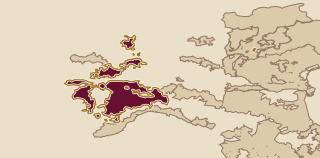
Alba sits at the centre of the Langhe hills in southern Piemonte, flanked by two of Italy's most demanding red-wine appellations. Barolo lies to the south and west, Barbaresco to the north and east. Both are built on Nebbiolo, and both are subject to the denomination rules that determine minimum ageing, yields and vineyard eligibility.
The Langhe hills divide between two distinct soil types that carry through into the wines. Barolo sits largely on Helvetian soils, compact marls and limestone that slow Nebbiolo's ripening and produce wines with firm tannin and long ageing potential. Barbaresco draws from the Tortonian soils of the Tanaro valley side, sandier and lighter, which bring earlier drinkability and a more open fruit character at similar ages. Pio Cesare holds vineyards in both zones, which gives the range its span from the approachable Langhe Nebbiolo through the single-vineyard Barolo bottlings.
In the cellar
Vineyards and cellar
The estate farms under SQNPI-certified integrated viticulture, Italy's national framework for production that avoids synthetic chemical inputs across soil management, canopy work and plant disease defence. In practice the estate uses green manure between the vine rows, mechanical weeding in place of herbicides, and integrated pest management that works with the vines' natural resistance rather than against it. Yields are kept low through green harvesting in summer and careful canopy management through the season.
Fermentation uses short macerations with separate-lot handling, which means parcels and vineyard blocks are vinified independently before any blending decisions are made. The selection happens after the cellar has seen what each lot produced. Ageing takes place in large French and Eastern European oak casks, which preserve Nebbiolo's aromatic character and allow the wine to develop without adding pronounced oak flavour. A portion of the blend spends limited time in smaller French barriques, which contributes some additional texture without replacing the character of the large-format wood.
Wines to know
The range in view
Nebbiolo runs through almost every bottle Pio Cesare produces. The range opens with Langhe Nebbiolo DOC, the lightest and most accessible tier, aged for nearly 18 months in large oak with a smaller proportion passing through French barriques. It offers Nebbiolo's typical dried cherry and rose petal aromas with firm but not harsh tannin and bright acidity.
The classic tier moves to Barolo DOCG and Barbaresco DOCG, both assembled from parcels across the respective denomination zones. These are the estate's broad denominational expressions, drawing from multiple villages and soil types to produce wines with more weight and tannin than the Langhe Nebbiolo and a longer ageing arc.
A useful way in
A bottle to begin with
Start with the Langhe Nebbiolo. It is pure Nebbiolo from Piemonte hillside parcels, aged for nearly 18 months in large oak, and it gives the grape's core character at a weight that does not demand years of patience. Dried cherry and dried rose on the nose, a palate with firm tannin and bright acidity, and a finish that stays clean and slightly earthy. It shows what Nebbiolo smells and feels like, what the grape's tannin does in the mouth, and why the variety needs the acid line it carries. Drink it alongside a meal rather than without one; Nebbiolo's tannin asks for food.