
Why it matters
The producer
Podere 29 is a family-run organic estate on the Tavoliere delle Puglie plain, founded in 2005 by Giuseppe Marrano in Tressanti, a hamlet in Cerignola, Foggia province. The name is not a marketing invention. It comes from the cadastral register: Plot 29, a numbered parcel of agricultural land assigned through a post-war redistribution programme designed to settle returning soldiers. The Marrano family farmed that plot. When they established the winery, they kept the number on the label.
Giuseppe Marrano runs the estate with a commitment to natural farming that draws on biodynamic principles, and oenologist Luca Pugliese makes the wines. Twenty hectares are under vine. Four indigenous Pugliese varieties supply the whole range: Nero di Troia, Primitivo, Susumaniello, and Minutolo. More than 40% of production leaves Italy, reaching EU markets, Asia, and beyond.
Place and vineyards
Where the wines begin
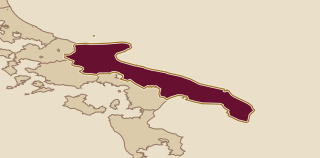
The Tavoliere delle Puglie is the largest plain in Italy after the Po Valley, a wide wheat-growing expanse in northern Puglia that runs to the Adriatic coast. Podere 29 sits near Cerignola, within reach of the Margherita di Savoia saltworks and flanked by the Ofanto and Carapelle river basins. The landscape is flat and open, exposed to sun and wind in equal measure.
Climate shifts as you move from coast to interior. Closer to the sea, conditions are Mediterranean: warm, moderately humid, tempered by Adriatic air. Inland at Cerignola, the character turns continental, with sharper swings between warm days and cool nights. Those diurnal temperature contrasts slow the final ripening of grapes, concentrate phenols, and build aromatic intensity in the fruit before harvest. The result on the label is wines from indigenous varieties that carry a particular freshness for southern Puglia.
In the cellar
Vineyards and cellar
The 20 hectares are farmed organically, certified by a recognised body, and managed with biodynamic principles that guide vineyard timing and intervention decisions. The Tavoliere climate demands attention to water management: summer heat is intense, and clay soils help buffer vine stress during dry periods. The four varieties are kept separate through harvest and vinification, each handled to preserve its native character rather than to impose a uniform house style.
In the cellar, Luca Pugliese uses French-oak barriques for two wines: Unio, the Nero di Troia and Primitivo blend, and Gelso d'Oro, the varietal Minutolo white. Gelso d'Oro spends eight months in French oak, long enough to add a spiced texture and roundness without overwhelming the grape's orange blossom and apricot character. Gelso Nero, the straight Nero di Troia, is vinified to keep the variety's red fruit, pepper and clove profile clear.
Wines to know
The range in view
The range has three wines, each a direct expression of one or two of the estate's four indigenous varieties.
Gelso Nero is varietal Nero di Troia, the dark-skinned grape historically associated with northern Puglia and the Castel del Monte DOC tradition. On the nose it shows red fruit alongside fig, black pepper and clove. In the mouth it carries the grape's characteristic chewy tannin and savoury spice, with the clay soils adding body and the diurnal temperature variation preserving freshness on the finish.
A useful way in
A bottle to begin with
Start with Gelso Nero. It is a varietal Nero di Troia grown on the Tavoliere plain at Cerignola, made without oak, and sent into the bottle to do one job: show what the grape tastes like when it is farmed carefully and left to speak clearly. Red fruit comes first on the nose, then fig, then black pepper and clove. In the mouth the tannin is present but not hard, the body is medium to full, and the spice from the grape carries through to a savoury finish. No oak to decode, no blending partner to separate out. One variety, one place, one bottle.