
Why it matters
The producer
Podere Il Carnasciale makes one grape and three wines from a hilltop in the Valdarno di Sopra, a DOC zone tucked into the province of Arezzo in eastern Tuscany. The entire estate covers 5.5 hectares. Of that, 4.5 hectares are planted to Caberlot across five separate plots. Caberlot is a natural crossing of Cabernet Franc and Merlot, and it does not exist in meaningful commercial quantity elsewhere.
That is not a marketing claim. It is the operational fact that governs everything about this address: every vine, every barrel, and every bottle comes from a single variety that the estate developed from an accidental crossing found here. Moritz Rogosky owns and runs the property today.
Place and vineyards
Where the wines begin
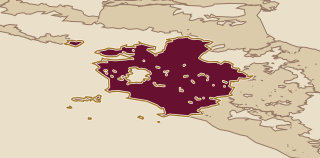
The Valdarno di Sopra, or Upper Arno Valley, runs between the Chianti mountains to the west and the Pratomagno range to the east. It received its own DOC recognition in 2011. The province is Arezzo, which places this estate east of Chianti Classico and well away from the coastal warmth of Maremma.
Podere Il Carnasciale sits on a hilltop inside the southern Chianti mountains, at an elevation that keeps the growing season cooler than the Maremma and produces grapes with a freshness and mineral drive that reviewers consistently note in Il Caberlot. The altitude matters: it is directly legible in the glass as acidity and energy rather than weight.
In the cellar
Vineyards and cellar
All five Caberlot plots are farmed by hand, with no mechanised vineyard work. The original home vineyard, planted in 1985, covers roughly one-third of a hectare and remains part of the estate's planted area.
In the cellar, Il Caberlot is fermented and then aged for 22 months in medium-toast Burgundian barrels, with around half of those barrels new each year. The wine is racked once during that period. It leaves the barrel without fining or filtration and rests in bottle for a further 16 months before going to market. No additives, no shortcuts to release.
Wines to know
The range in view
Three wines, one grape, one estate.
Il Caberlot: Single-vineyard fruit from the original and expanded Caberlot plots, aged 22 months in medium-toast Burgundian barrels at roughly 50 percent new, unfined, unfiltered, and held in bottle for 16 months before release. In the glass, it delivers red cherry, plum, orange peel, spice, licorice, cedar and new leather, driven more by energy and mineral freshness than by body or weight.
A useful way in
A bottle to begin with
Start with Il Caberlot. It is the wine that has built the estate's reputation since the first vintage in 1988, and it is the clearest expression of what Caberlot does on this hilltop in Arezzo.