
Why it matters
The producer
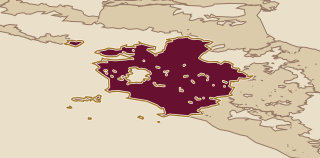
Podere Poggio Scalette sits on Ruffoli hill in the Greve in Chianti commune, one of the southernmost and highest-altitude corners of the Chianti Classico zone in central Tuscany. Vittorio Fiore and his wife Adriana Assjè di Marcorà founded the estate in 1991, buying land and a farmhouse on the hill. They had nothing purpose-built: no cellars, no working space beyond the farmhouse itself. Five years later they acquired the adjoining property, which came with functional cellars, and the full production model clicked into place.
The estate now covers 40 hectares: 15 in Sangiovese vines, 10 in olive groves. Jurij, Vittorio's son and a graduate of the School of Viticulture and Oenology in Beaune, Burgundy, runs the day-to-day farming and winemaking. Alessandro, the other son, handles export markets. Vittorio keeps overall oversight. Three family members, three defined roles.
Place and vineyards
Where the wines begin
Ruffoli hill falls within the Greve in Chianti commune, the northernmost of the major Chianti Classico communes, and sits at elevations where the diurnal temperature shift keeps Sangiovese firm long into the growing season. The vineyards face west and south at high, breezy altitudes, which delays full ripeness and holds the natural acidity the appellation's Sangiovese is known for.
The soil is Macigno, a local sandstone formation. Sandstone drains quickly, limits vine vigour, and produces grapes with concentrated colour and a mineral, iron-edged character. It is a leaner growing environment than the galestro and alberese clay-limestone soils found elsewhere in Chianti Classico. The combination of altitude, exposure and sandstone gives the estate's wines a tighter, more saline frame than many Chianti Classico estates on lower ground.
In the cellar
Vineyards and cellar
The 15 hectares of Sangiovese vine on Ruffoli face west and south on Macigno sandstone. The high altitude slows ripening and keeps acidity elevated; the sandstone encourages small, concentrated grapes. Both factors point the winemaking in one direction: preserve what the hill gives, add as little as possible in the cellar.
For the Chianti Classico, use cement throughout. Alcoholic and malolactic fermentation both happen in cement tanks. The wine spends ten months in cement after fermentation, then at least three months in bottle before release. No oak contact at any stage. This is a wine where every aromatic and textural character comes from grape and site: no vanilla or spice overlay from barrel, no tannin softened by new wood.
Wines to know
The range in view
The estate's range runs from Chianti Classico at entry level through to Il Carbonaione as a single-vineyard bottling. Five further wines, Capogatto, Piantonaia, Chiara, Aurora and Richiari, complete the list.
Poggio Scalette Chianti Classico is 100% Sangiovese, specifically identified as Sangiovese di Lamole, a clone associated with the Lamole valley in Greve in Chianti. Fermented and aged in cement, unoaked. Full-bodied with sour cherry and black cherry fruit, pomegranate, iron, abundant acidity and tannin that grips without roughening. The crisp finish is the signature of cement-only élevage on a sandstone hill: no woody softening, no barrel sweetness, just Sangiovese in its direct, mineral form.
A useful way in
A bottle to begin with
Start with the Poggio Scalette Chianti Classico. It is 100% Sangiovese di Lamole, fermented and aged entirely in cement, unoaked, from west and south-facing parcels on Macigno sandstone at high altitude in Greve in Chianti. The wine costs less than Il Carbonaione and presents Sangiovese, sandstone, altitude and no oak in one bottle: Sangiovese, sandstone, altitude, no oak. Sour cherry, iron, abundant acidity, tannins that are firm rather than rough, and a clean mineral finish. Nothing is added in the cellar to smooth the hill's edges.