
Why it matters
The producer
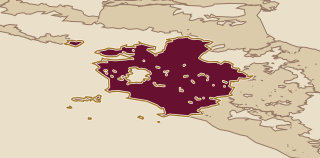
Podere San Cristoforo sits on the Tuscan coast in Maremma, the broad coastal arc that runs south of Livorno and opens toward the Tyrrhenian Sea. Lorenzo Zonin, from a family with generations of Italian winemaking behind them, owns and runs the estate. What makes the address unusual is not the family name but the grape: Petit Verdot, a variety that rarely survives a northern European growing season, ripens fully here on graphite- and iron-rich soils cooled by ocean breezes, and becomes a varietal wine with no blending partner required.
The estate farms without synthetic fertilisers, insecticides or herbicides. Copper and sulfur are the only vineyard treatments. Vines are dry farmed, biodiversity is actively managed, and every harvest comes off by hand at night. Yields are kept low and the winery is deliberately light on technology. The estate makes three distinct wines from a site with a genuinely unusual climatic argument.
Place and vineyards
Where the wines begin
Maremma was long regarded as marginal: malarial lowlands that the Medicis drained and that modern wine investment only reached in the 1980s and 1990s. The coastal strip, though, carries a different logic. Warm days and sea winds hold temperatures, extend the growing season, and allow varieties that need prolonged warmth to ripen completely. Petit Verdot, which struggles to reach full maturity in Bordeaux, finds on the Tuscan coast the heat accumulation it requires. The soils at San Cristoforo are graphite- and iron-rich, which keeps vigour in check and pushes the vine's energy toward concentration rather than canopy. Ocean air circulates through the vineyard and moderates the ripening curve, preserving acidity alongside the fruit weight the coast delivers.
Labels from this part of Maremma sit outside the Bolgheri appellation to the north. San Cristoforo's wines carry the broader coastal address rather than a village classification, which places attention on the farming and the grape choices rather than on appellation hierarchy.
In the cellar
Vineyards and cellar
Harvesting at night keeps grapes cool from vine to winery, protecting aromatic compounds that heat would volatilise during transport. Before fermentation, workers sort the incoming fruit by hand, removing broken, dried and unripe berries so only clean material enters the vat.
Baci di Sangiovese ferments in stainless steel for seven days with indigenous yeasts, keeping the fermentation environment neutral and the fruit character unmasked by commercial yeast signatures. Malolactic conversion takes place in barrel immediately after fermentation, which integrates the softening of malic acidity with the first weeks of oak contact rather than treating them as separate operations. The wine then matures for ten months in used French-oak barriques. Used barrels add a low-level oak presence without pushing vanilla or toast to the foreground.
Wines to know
The range in view
The range has three distinct poles. The Petit Verdot varietal is the estate's most distinctive bottle: a 100% varietal wine from a coastal zone that is among the few in Italy capable of ripening the variety fully. The vine grows on graphite- and iron-rich soils in scattered parcels caressed by ocean breezes, and the wine carries the deep colour and firm tannin the variety delivers when it reaches complete maturity. Full vinification details for the Petit Verdot are not published in the same detail as the Sangiovese, but the farming philosophy is identical across the range.
Identità is the most experimental wine in the range: a skin-macerated white from Trebbiano and Vermentino, produced without added sulphites, from the oldest vineyard on the estate. The 2017 vintage produced only 1,960 bottles. It carries the amber colour, textural weight and dried-orchard character typical of extended skin contact, with a savouriness that zero-sulphite production tends to deliver when the farming is clean enough to support it.
A useful way in
A bottle to begin with
Baci di Sangiovese 2022 is the most complete introduction to what San Cristoforo does. It is 100% Sangiovese from a Montalcino-derived clone, fermented with indigenous yeasts in stainless steel, finished with malolactic conversion in barrel, and matured ten months in used French oak. At 12.5% alcohol, it sits on the lighter side of coastal Tuscany reds, which means the fruit and the farming are carrying the wine rather than alcohol weight. Cherry, sweet spice and gentle tannin come through clearly, and the oak has been managed to support rather than lead. Start here to understand what biodynamic farming on coastal Maremma soils delivers when the cellar work is kept deliberately light.