
Why it matters
The producer
Lorenzo Zonin owns and makes the wine at Podere San Cristoforo, a small biodynamic estate on the Tuscan Coast where two grapes do things they rarely do elsewhere. One is Sangiovese, grown not from nursery clones but from six distinct biotypes sourced from historically important Tuscan vineyards and re-propagated together in a single named plot. The other is Petit Verdot, a grape almost always lost inside Bordeaux blends, grown here on its own from coastal gravel with enough freshness to stand alone.
Zonin works with Davide Elisei, who manages the estate and oversees viticulture, and cellar master Filippo Paolicchi. The three of them run a property where almost every standard winemaking input has been subtracted. Commercial yeast is out. Synthetic fertilisers, insecticides and herbicides are out. In the vineyard, the treatments are copper and sulfur. In the cellar, the goal is the lowest possible chemical or mechanical intervention. The winery itself is built underground to reduce the energy required to keep it cool.
Place and vineyards
Where the wines begin
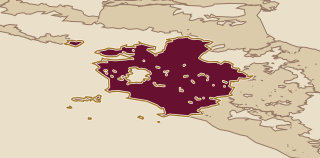
The Tuscan Coast, running south from Livorno toward Grosseto, carries a different climate from the inland hills of Chianti or Montalcino. Sea breezes arrive consistently from the Tyrrhenian, cooling the vines through the afternoon and keeping acidity alive through long, sun-filled summers. That combination of warmth and marine air is what makes varietal Petit Verdot possible here. In the inland heat of Bordeaux or most of Tuscany, Petit Verdot ripens too late and too heavily to carry a bottle on its own. On this coastal strip, the breeze slows the ripening just enough.
Sangiovese also reads differently at the coast. Without the altitude and clay of Chianti Classico or the volcanic tufa of Montalcino, it leans toward freshness and direct fruit rather than weight. At Podere San Cristoforo, the Carandelle vineyard produces a Sangiovese that is specific to this patch of coast, shaped as much by the selection of biotypes as by the soil beneath them.
In the cellar
Vineyards and cellar
In the vineyard, the only approved treatments are copper and sulfur, the two substances permitted across biodynamic and organic regimes for disease management. No synthetic chemistry touches the soil or the vine. Manual labour replaces most mechanical work: yields are kept low through hand work rather than mechanised hedging or thinning. Biodiversity across the estate, the olive trees, cork oaks and ground cover between rows, is treated as a farming asset rather than a cosmetic backdrop.
In the cellar, the Carandelle goes through a seven-day fermentation in stainless steel with only indigenous yeasts. Malolactic fermentation, the conversion of sharp malic acid into softer lactic acid, happens spontaneously in barrique rather than being triggered by inoculation. The wine then matures for ten months in old French-oak barriques. Old oak imparts very little flavour; it allows slow micro-oxygenation that softens tannin without adding vanilla or toast.
Wines to know
The range in view
The range at Podere San Cristoforo is built on two grapes that rarely share a producer's focus.
Carandelle is a red wine from the named Carandelle vineyard, made from six Sangiovese biotypes co-planted and co-fermented in a single plot. The 2022 is 99% Sangiovese; the remaining fraction is indicated on the label by a heart rather than a declared variety. Seven days on skins in stainless steel, spontaneous malolactic in barrique, ten months in old French oak. The wine is fresh and persistent, with morello cherry, raspberry and blackcurrant in the fruit register and a thread of liquorice and spice behind them. Tannin is present but fully integrated into the fruit, neither grippy nor absent.
A useful way in
A bottle to begin with
Start with Carandelle 2022. It is the wine that shows every decision the estate makes in a single bottle: the six biotypes grown together in one plot, the indigenous yeast, the spontaneous malolactic, the old French oak that seasons tannin without flavouring the wine. Morello cherry and raspberry on the nose, clean acidity on entry, fine-grained tannin mid-palate, and a finish that carries the fruit and spice forward without sweetness or weight. It is a coastal Tuscan red that is specific rather than generic, interesting rather than comfortable, and honest about what the place and the method can produce.