
Why it matters
The producer
At Bussia in Monforte d'Alba, Poderi Aldo Conterno farms 25 hectares across the three highest hills of the Bussia subzone, a compact position from which the estate draws its entire production. Bussia is a prominent south-southwest-facing ridge at around 400 metres above sea level where the calcareous marl and sandy soil produce Nebbiolo with firm tannin and the capacity to age for decades.
Aldo Conterno founded the estate in 1969 after dividing the family domaine with his brother Giovanni. The split came because the brothers found working together difficult, though stylistic disagreement has often been assumed as the cause. From 14 hectares at founding, the estate grew to 25, all remaining within Bussia. Today Aldo's three sons run the operation: Stefano makes the wines, Franco promotes them, and Giacomo looks after the vineyards.
Place and vineyards
Where the wines begin
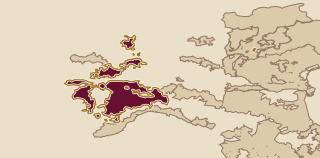
Bussia is a hill within the Monforte d'Alba commune, one of the communes comprising the Barolo production zone in Piedmont. The Barolo appellation is built around Nebbiolo, a late-ripening variety that needs south or south-southwest exposures and well-drained, calcareous soils to ripen fully without losing the acidity and tannin that allow the wines to develop over years in bottle.
Poderi Aldo Conterno sits at the upper end of Bussia, on its three highest hills, at roughly 400 metres. The elevation gives a longer growing season with more pronounced day-to-night temperature variation, which helps preserve aromatic complexity and acidity in the Nebbiolo.
In the cellar
Vineyards and cellar
All 25 hectares are within Bussia on its three highest hills, managed with organic methods, though the estate has not published a certifying body. Fruit is harvested by hand, with mid-October the typical picking window.
Fermentation takes place in temperature-controlled stainless-steel tanks. For the Barolos, the must stays in contact with the skins for 30 days, during which alcoholic fermentation completes. The extended skin contact extracts the colour, tannin and grip that Barolo requires for long ageing. After maceration the new wine is racked several times, then transferred to Slavonian oak casks ranging from 25 to 75 hectolitres, which are replaced on a 15 to 18-year cycle. Slavonian oak is a traditional Barolo choice: the large cask size limits the ratio of wood surface to wine, so the oak influence is gradual and the contribution of vanilla or toast is far smaller than it would be in smaller French barrels. Selected yeasts are not used.
Wines to know
The range in view
The four Barolos divide into two tiers. Cicala, Colonnello and Romirasco are the single-vineyard wines, each bottled under the Barolo Bussia DOCG designation and each expressing the character of its named section of the hill. Granbussia is the blend of the three sites, made only when the vintage quality justifies it and given a longer ageing period before release than the single-vineyard wines.
Cicala comes from the parcel where Lampia dominates. Colonnello, where Michet leads, is described by one professional assessment as the most balletic of the single-vineyard wines, its fruit carried by strictness and sinew. The two wines share the same 30-day maceration and the same large-cask élevage but express their parcels differently.
A useful way in
A bottle to begin with
Colonnello is the bottle to open first. Among the single-vineyard wines, it is the one professional assessors describe as the most balletic, its firm tannin and bright acidity carrying fruit that feels pure rather than austere. The Michet-dominant Colonnello vineyard produces a wine that shows the Bussia character, the large-cask oak regime, and the estate's commitment to 30-day maceration without Cicala's more introverted, earth-first disposition in youth. It is still a wine that rewards several years in the cellar, but it offers more fruit presence earlier in its life, a clearer introduction to what these Barolos are before moving to the darker Cicala or to Granbussia in a top vintage.