
Why it matters
The producer
Poderi Cellario sits in Carrù, on the western edge of the Langhe, where the hills flatten out well before the famous classified zones of Barolo and Barbaresco begin. Fausto and Cinzia Cellario are the third generation to farm here, working approximately 30 hectares of hillside parcels across five sites. They make only wines from indigenous Piedmontese varieties: Nascetta, Moscato Giallo, Dolcetto, Nebbiolo. No international grapes, no shortcuts.
The estate describes itself as a group of friends as much as a family business. Farming began in 1971, first for pleasure, then as a profession. What drives the wines now is a set of convictions accumulated over decades: that the land responds to care rather than chemistry, that fermentation works best with the yeasts already present, and that the cellar does its job quietly, without temperature control or significant added sulfur.
Place and vineyards
Where the wines begin
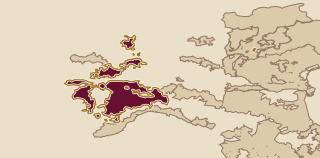
Carrù is not a name wine buyers typically encounter on a label. The Langhe is famous for its classified hillsides around Alba, Barolo, and Barbaresco, and Carrù sits to the west of that corridor, outside the prestige appellations. The five vineyard sites spread across the southern Langhe: Farigliano, Dogliani (San Luigi), Carrù, and Piozzo, all on hillside parcels.
Being outside the classified zones has consequences in the glass. The wines carry a quieter, less extracted character than Barolo or Barbaresco. The Langhe Nebbiolo appellation, which Galli uses, covers a wide area and allows grapes grown across this southern stretch to reach the bottle under a single regional label rather than a village name.
In the cellar
Vineyards and cellar
Grass grows between the vine rows year-round. Before a new vineyard is planted, manure replaces artificial fertiliser, and the estate periodically sows legumes and grasses to restore soil balance. Pest control uses mating disruption rather than insecticides: pheromone dispensers confuse damaging insects and reduce their populations without chemical intervention.
In the cellar, the two levels handle different jobs. Ground level holds stainless-steel tanks for vinification: clean, easy to sanitise, requiring no chemical additives. The lower underground level holds the wines through maturation in cement tanks, clay amphorae, and wood. Fermentation runs on indigenous yeasts throughout. Sulfur goes in only in small amounts at bottling, and only when the wine genuinely needs it.
Wines to know
The range in view
Three wines sit at the centre of the range, each using a different grape and a different style.
Il Baffone is a pét-nat frizzante made from Nascetta, a rare white Piedmontese variety, blended with Moscato Giallo vinified dry. The wine referments naturally in bottle, is left unfiltered to preserve the sparkle, and carries a persistent but light mousse. The fruit register sits in yellow: pear, apple, apricot. A saline edge cuts through the fruit, and the acidity is lively.
A useful way in
A bottle to begin with
Start with Il Baffone. It is a pét-nat made from Nascetta and dry Moscato Giallo, refermented in bottle, unfiltered, with no added sulfur. Pear, apple and apricot come first, then a saline edge and a bright acid line across the fine persistent sparkle. No heaviness, no sweetness, no oak. The bottle was named after Tonio, Cinzia's father, who taught Fausto the bottle-sparkling technique: the label carries a drawing of a moustache, Il Baffone.