
Why it matters
The producer
In 2004 Paolo and Giovanni Bulgari bought a property in Palazzone, in the municipality of San Casciano dei Bagni, and found the vineyards entirely abandoned. They could have replanted cautiously. Instead they cleared everything, replanted with five varieties, and waited. The first harvest came in 2009, five years after purchase.
The cellar followed in 2013, designed by architects Massimo Alvisi and Junko Kirimoto. The building is precise and intentional, a working winery that also reads as a considered object in the landscape. Three wines now come from it: Therra, a Sangiovese-led blend; Sotirio, a single-variety Sangiovese; and Argirio, a Cabernet Franc. The estate farms organically and harvests entirely by hand. The wines carry IGT Toscana on the label, which gives the estate latitude to blend freely and use varieties that fall outside the local DOCG rules.
Place and vineyards
Where the wines begin
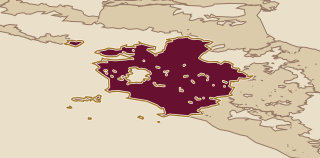
San Casciano dei Bagni sits in the far south of Tuscany, close to the border with Umbria and Lazio. It is not Chianti country. There are no famous classified growths nearby, no appellation hierarchy with centuries of reputation behind it. The landscape is quieter and less trafficked than the Classico zone further north.
The wines carry the IGT Toscana designation, which is a region-wide category rather than a village or sub-zone appellation. That label choice is also a practical one: it allows Podernuovo to plant and blend Cabernet Franc, Cabernet Sauvignon, Merlot, and Petit Verdot alongside Sangiovese without being constrained by rules that would require a single-variety or majority-Sangiovese composition. An estate working in Chianti Classico DOCG would face different blending requirements. Here the grape selection and the label are directly connected.
In the cellar
Vineyards and cellar
The replanted vineyard carries five varieties: Sangiovese, Cabernet Franc, Cabernet Sauvignon, Merlot, and Petit Verdot. Organic farming covers the whole estate; rows are grass-covered and fertilised with fava beans.
Therra, the blend of Sangiovese, Cabernet Sauvignon, and Merlot, spends 15 to 25 days on the skins, ferments in temperature-controlled stainless steel, then ages for ten months in large 3,000-litre oak barrels. The large-format barrel limits the oak contact per volume of wine, so the wood contributes without dominating. Six months in bottle follow before release. Therra has lively tannins, juicy fruit and a long, persistent profile.
Wines to know
The range in view
The three wines are separate answers to the same replanted vineyard rather than a hierarchy moving from entry to prestige.
Therra blends Sangiovese, Cabernet Sauvignon, and Merlot. It is the most generous in early life: the Merlot rounds the mid-palate, and the Sangiovese keeps the acidity moving through the finish. Tannins are lively without being demanding. Blueberry and berry fruit open the nose; sweet spice, aromatic herbs, and a thread of toast come through over time. It drinks well with a few years of age and does not require long cellaring.
A useful way in
A bottle to begin with
Start with Therra. It is Sangiovese, Cabernet Sauvignon, and Merlot aged for ten months in large oak barrels, and it gives a clear picture of what the estate does: ripe southern Tuscan fruit, real skin contact, oak that supports rather than leads, and a finish long enough to hold interest. The lively tannins and juicy mid-palate make it approachable from release.