
Why it matters
The producer
Marilisa Allegrini arrived in Bolgheri in 2001 with a specific ambition: to build a Tuscan coastal estate from empty land. She and her brother Walter had made their name in the Veneto with the family's Valpolicella and Amarone wines. Bolgheri was a different argument entirely. The Maremma coast, not the northern hills. International varieties, not Corvina and Rondinella. A DOC whose reputation had been written by Sassicaia, not by the Allegrini family.
They bought 105 hectares in the Bolgheri commune and began a planting program in 2003, mapping the land across four distinct vineyard plots. Walter died that same year. Marilisa did not sell. She kept planting, kept building, and brought her daughters Carlotta and Caterina into the leadership over time. The estate Walter helped conceive is now led entirely by women.
Place and vineyards
Where the wines begin
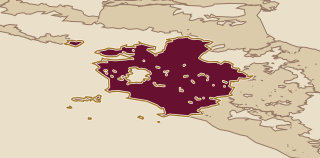
Bolgheri is a Tuscan coastal DOC south of Livorno, in the zone called the Maremma. Its international reputation was built by Sassicaia, the estate that demonstrated Cabernet Sauvignon and Cabernet Franc could ripen fully on the Tyrrhenian coast and age as well as any wine in Italy. That success reshaped the DOC's permitted varieties and its ambitions. Today Bolgheri allows Cabernet Sauvignon, Cabernet Franc, Merlot, Syrah, and Vermentino, and its two label tiers, Bolgheri DOC and Bolgheri Superiore, separate wines primarily by minimum ageing and grape composition thresholds.
The climate is Mediterranean with a maritime edge. The Apennines to the east block cold continental air; the Tyrrhenian Sea to the west moderates summer heat and extends the growing season. Long sun hours push phenolic ripeness in the reds and keep natural acidity in the whites. The result on the label is fruit concentration paired with savory mineral character, a combination blind tasters consistently associate with the appellation.
In the cellar
Vineyards and cellar
Poggio al Tesoro farms 64 hectares across its four plots. The planting is oriented toward international red varieties for the Bolgheri reds and Vermentino for the white, a direct reflection of the DOC's permitted range and the stylistic ambitions Marilisa set for the estate.
The two red wines differ most clearly in their time in wood. Il Seggio receives 15 months in French oak, with 30 per cent new barrels, giving the wine enough oak integration to support its fruit without dominating it. Sondraia receives 22 months in French oak, with 70 per cent new barrels, a significantly longer and more intensive élevage that shapes the Superiore's deeper tannin frame and darker fruit character. The gap between 30 per cent and 70 per cent new wood is not a subtle one; it marks a deliberate separation between two wines meant to occupy different positions in the range and on the table.
Wines to know
The range in view
Poggio al Tesoro makes three wines: two Bolgheri reds and one Vermentino-based white.
Il Seggio carries Bolgheri DOC status, the entry tier in both the DOC hierarchy and the estate's own range. It is a red blend from international varieties, aged 15 months in French oak with 30 per cent new barrels. Blind tasting finds earthy, mineral, and peppery aromas alongside graphite, bergamot, and blackberry on the nose. The palate adds berries, stone fruit, and a note of peach tea. Tannins are described by Wine Enthusiast as big and solemn; the producer characterizes them as silky. Both observations are consistent with a young Bolgheri red from a maritime growing season: the tannins are present and framing, not soft.
A useful way in
A bottle to begin with
Start with Il Seggio. It is the Bolgheri DOC entry wine: shorter oak time, lower proportion of new wood, lower price, and more open in the glass than the Superiore. The nose gives you the appellation character cleanly, earthy mineral notes, blackberry, and that distinctive peppery graphite quality that shows up consistently in blind tastings of the zone. The palate adds stone fruit and the berry concentration you expect from long coastal sun. The tannins are dry and framing, which tells you what the wine is made of and where it comes from, without the additional weight the Sondraia adds through seven extra months in barrel and twice the new oak proportion.