
Why it matters
The producer
Portal del Priorat is the wine project Alfredo Arribas began in 2001 after buying Clos del Portal. Arribas came to the estate from architecture, and the property still joins vineyard and building: its winery stands within the estate as ecological architecture integrated into the surrounding land. The result is a range rooted in a particular Priorat holding rather than a single house style, moving from the mixed-grape Negre de Negres to Tros de Clos, a separate wine from an old Cariñena slope.
Arribas bought Clos del Portal in 2001 and began a Priorat wine project after working as an architect in Barcelona. The estate covers 40 hectares, though only 14 hectares are planted to vine, leaving the winery and vineyard blocks within a larger landscape. That scale helps explain the project’s two directions: an integrated estate winery for the wider range, and close attention to particular planted sites such as the old Cariñena coster behind Tros de Clos.
Place and vineyards
Where the wines begin
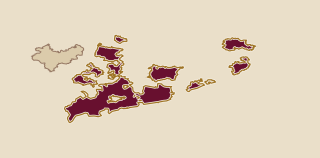
Clos del Portal sits in the southern part of Priorat, near El Lloar and Bellmunt. Its vineyard layout brings the place into the bottle in two physical forms: terraces hold vines on constructed levels, while costers place vines directly on the slope. Negre de Negres combines fruit from the estate’s planted varieties; Tros de Clos narrows the view to one Cariñena vineyard, so the range shifts from a blended red to a single-vineyard expression.
In the cellar
Vineyards and cellar
The vineyards are farmed biodynamically and planted at high density. Garnacha, Cariñena, Syrah, Cabernet Franc and experimental grapes grow across the estate, supplying more than one route into red wine: Garnacha, Cariñena and Syrah meet in Negre de Negres 2022, while Cariñena alone forms Tros de Clos. The winery’s placement on the estate keeps the practical connection visible between those vineyard parcels and the finished bottles, without requiring a claim about unrecorded cellar vessels or extraction methods.
Wines to know
The range in view
Portal del Priorat’s documented range has three useful points of contrast. Negre de Negres 2022 is the earlier-picked blend: 50% Garnacha Tinta, 30% Cariñena and 20% Syrah. Its fleshy body, earthy character, ripe black fruit and delicate smoky accent show how three varieties can build weight without relying on one grape alone.
Somni takes the range toward greater concentration than Negre de Negres. Tros de Clos moves in the other direction, reducing the wine to one vineyard and one grape: 100% Cariñena from the coster planted in 1911. Together, the bottles set a clear choice between blended fruit, a more concentrated red, and a site-specific Cariñena wine.
A useful way in
A bottle to begin with
Choose Negre de Negres 2022 first. It names the estate’s red-grape foundation in measurable terms—50% Garnacha Tinta, 30% Cariñena and 20% Syrah—and places those grapes in a bottle with ripe black fruit, earth, a fleshy mid-palate and a light smoky edge. It is the most direct way into Portal del Priorat’s multi-variety plantings before moving to the more concentrated Somni or the single-vineyard Cariñena of Tros de Clos.