
Why it matters
The producer
Prunotto sits in Alba, the commercial capital of the Langhe, exactly midway between the Barolo zone to the southwest and Barbaresco to the northeast, on the right bank of the Tanaro River. That geography is not incidental: the winery's range runs across both great Nebbiolo appellations, with a footprint in Barbera and lighter wines that fills in everything around them.
The house began as a cooperative. In 1904, in the council room of Serralunga d'Alba's town hall, a winemaking co-operative called Cantina Sociale "Ai Vini delle Langhe" was formally incorporated, with a young Alfredo Prunotto present as a witness. The first harvest followed in 1905. Prunotto eventually gave the enterprise his name and ran it as a private concern until 1956, when he retired and sold to Beppe Colla.
Place and vineyards
Where the wines begin
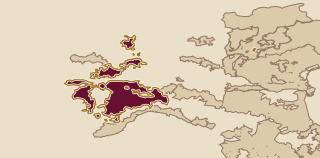
Alba stands at the centre of the Langhe, the ridge-and-valley hill country of southern Piemonte where Nebbiolo produces two legally separate wines from two distinct zones. Barolo DOCG lies to the southwest, its communes including La Morra, Castiglione Falletto, Serralunga d'Alba and Barolo itself. Barbaresco DOCG sits northeast of Alba, covering the communes of Barbaresco, Treiso, Neive and part of Alba. Barbaresco received DOC status in 1966 and DOCG designation in 1980.
Prunotto works vineyards across both zones, extending also into the Monferrato hills further east for Barbera d'Asti. The Tanaro River, which flows past Alba, is the rough dividing line between the Langhe to the south and the Roero to the north, where the Arneis grape produces the estate's white wine. Operating from Alba means access to all of these appellations without belonging fully to any single commune, a position that explains why Prunotto's range is broader than most single-village estates.
In the cellar
Vineyards and cellar
Prunotto farms approximately 65 hectares across the Langhe and Monferrato, working each parcel as a distinct unit with rootstocks and clones chosen from detailed soil analysis. Sustainable agriculture guides the approach, with a deliberate emphasis on manual work through the growing season. Harvest is done by hand across the estate.
Wines to know
The range in view
Nebbiolo carries the range at three levels. At the top, Barolo DOCG comes from two parcels in the Barolo zone: Bussia, the flagship vineyard the estate has worked since 1961, and Bussia Vigna Colonnello, a sub-plot within Bussia that is vinified and bottled separately. These are full-scale Barolo: high tannin, firm acidity, dark cherry and dried rose aromatics from Nebbiolo grown on the calcareous marl of the Monforte area, with the ageing depth to hold for ten to twenty years in good vintages. Barbaresco DOCG comes from Bric Turot and Bansella, two named parcels in the Barbaresco zone northeast of Alba. Nebbiolo from Barbaresco typically produces wines with slightly finer tannin and earlier accessibility than Barolo, though Prunotto's Barbaresco 2023 is pure Nebbiolo vinified to age. Occhetti is the third Nebbiolo expression: a Langhe DOC from a named vineyard the estate has supplied since the 1970s, fermented and aged to be approachable within a few years. It carries the grape's characteristic tannin and red-cherry fruit with less weight than the DOCG wines.
A useful way in
A bottle to begin with
Start with Occhetti Langhe DOC Nebbiolo. It is the most direct path into what Prunotto does with the region's defining grape: the same Nebbiolo variety that fills the Barolo and Barbaresco labels, from a named vineyard the estate has farmed since the 1970s, vinified to be accessible within a few years. In the glass, Occhetti gives red cherry, a thread of dried rose, firm but approachable tannin, and the high, clean acidity that defines Nebbiolo wherever it grows in the Langhe. There is enough vineyard character to understand the grape's personality without the full weight and ageing demand of the DOCG wines.