
Why it matters
The producer
Purista brings Ana Cardoso Pinto’s work in architecture into the vineyard and cellar. Her minimalist architectural language informs a minimal-intervention approach: organic vineyard work, spontaneous fermentation, concrete tanks, low sulfites, and no stabilisation or filtration where documented. Those decisions put grape and vintage ahead of conspicuous cellar flavour, particularly in the dry Encruzado bottling.
Wine was part of Pinto’s working life before Purista had a label. She had joined harvests from 2003, began formal wine study at UC Davis in 2011, then completed sommelier training at the Culinary Institute of America in Napa Valley. From 2012 she worked across vineyard, cellar, sales and marketing at her family winery. Planting her own vineyards in 2019 turned that broad experience towards a separate project, and Purista followed in 2021 with wines shaped around concrete, wild yeast and modest additions of sulphur.
Place and vineyards
Where the wines begin
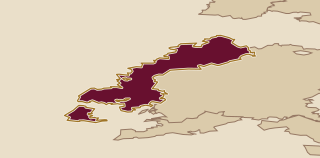
Purista is associated with Alenquer in Lisboa, north of Lisbon. On Encruzado Purista 2023, Lisboa is more than a regional line on the label: it locates a Portuguese white made from Encruzado, a local grape whose citrus, floral and mineral notes carry the wine’s character. The range also includes red wines, so the project is not confined to one colour or one grape.
The documented site detail is agricultural rather than geological. Pinto began planting her own vineyards in 2019 and uses organic methods, including sheep for weed control. That keeps ground cover management in the vineyard rather than relying only on machinery or herbicides; the resulting wines are presented through their fruit, acidity and texture rather than unsupported claims about a named soil or slope.
In the cellar
Vineyards and cellar
Purista is separate from the Cardoso Pinto family winery, while using the family cellar’s 19th-century concrete tanks. Concrete is central to the documented cellar picture: fermentation begins spontaneously with wild yeast, then the wines are handled with low sulfites and, where documented, without stabilisation or filtration. The approach avoids a formula of strong oak flavour or heavily adjusted texture. In the white wine, it leaves room for citrus fruit, floral aroma, mineral notes and a salty edge to remain distinct.
Organic vineyard work and low-intervention cellar practice are connected here by timing. Pinto planted in 2019, then released the Purista brand in 2021 as the project took shape. Rather than treating vineyard and cellar as separate departments, the label carries both decisions into a compact range: fruit grown under organic methods, then fermented and raised with a short list of documented inputs.
Wines to know
The range in view
Purista began with two wines and had expanded to four by 2024, divided between white and red styles. Encruzado and Tinta Miúda joined the range in that expansion.
Encruzado Purista 2023 supplies the firmest taste reference. It is a dry white Lisboa wine from Encruzado at 12% alcohol. Its citrus and floral fruit sit on a light-bodied palate, while mineral notes and a subtly saline finish stop the wine from reading as simply fruity. The modest alcohol supports a fresh, clean line rather than broad weight.
A useful way in
A bottle to begin with
Start with Encruzado Purista 2023. It is the named bottle that joins Purista’s place, grape and cellar work in one glass: white Encruzado from Lisboa, 12% alcohol, spontaneous fermentation and concrete in the documented method. Expect dry citrus, floral perfume, mineral notes, fresh acidity and a light saline finish. Its light body makes the vineyard-and-cellar approach easy to taste without needing a comparison bottle beside it.