
Why it matters
The producer
Quinta D´Amares is an estate rather than a patchwork of separately named vineyard purchases: its roughly 50 hectares run as one connected holding in Amares municipality. That continuity carries through to bottles such as Amare 2023, where Loureiro and Alvarinho meet cool fermentation and gentle pressing in a dry, low-alcohol white.
The estate works within two classifications. A Vinho Verde DOP label places a wine in the demarcated Vinho Verde appellation, while Vinho Regional Minho IG marks a regional Minho wine; on Quinta D´Amares bottles, those terms sit alongside the grape names that explain what is in the glass.
Place and vineyards
Where the wines begin
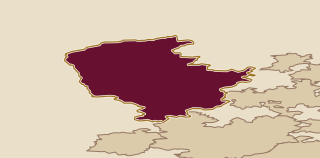
Santo André de Rendufe lies in the Vinho Verde demarcated region, beside the Monastery of Rendufe. The estate’s sunny southern exposure gives the vines more direct light, supporting ripening while the region’s white-wine setting remains central to blends such as Loureiro–Alvarinho Amare 2023.
Amares appears on the estate’s address, but the bottle tells the more useful wine story through its classification and grapes. Amare 2023 names Loureiro and Alvarinho; the Vinho Verde designation places that blend within the northern Portuguese region where the estate farms its continuous vineyard.
In the cellar
Vineyards and cellar
A continuous vineyard holding lets Quinta D´Amares work one estate area rather than assembling a white wine from scattered growers. The supported cellar choices are equally direct: gentle pressing limits hard extraction from the grapes, while stainless steel avoids adding oak aroma to Loureiro, Alvarinho and Arinto-based whites.
Fermentation is temperature-controlled between 13°C and 15°C. That cool range is used to preserve fruit character, so Amare 2023 can show pear, citrus peel and tropical fruit notes with only 10% alcohol and less than 0.3g of sugar per 100ml, finishing dry rather than sugary.
Wines to know
The range in view
The documented range moves through two label frameworks, Vinho Verde DOP and Vinho Regional Minho IG, with white blends providing the clearest view of the estate. Amare 2023 is Vinho Verde made from Loureiro and Alvarinho: a dry, 10% white whose fruit-led profile keeps the body light and the finish clean.
A second documented wine, Quinta de Amares Loureiro e Arinto Superior Branco Vinho Verde, pairs Loureiro with Arinto under the Vinho Verde designation. Set beside the Loureiro–Alvarinho Amare, it shows that Loureiro is not treated as a single-variety statement here: the partner grape changes the blend while stainless-steel handling keeps the range in a fresh white-wine register.
A useful way in
A bottle to begin with
Start with Amare 2023, a Vinho Verde white made from Loureiro and Alvarinho. It brings the estate’s key facts together in one bottle: grapes from the south-facing holding, gentle pressing, fermentation at 13–15°C, stainless-steel handling, 10% alcohol and a dry finish. Expect yellow pear, herbs, honeydew, pineapple, citrus peel and yellow plum, with bright fruit rather than oak weight. It is the most fully documented way into Quinta D´Amares because both the blend and the cellar approach are visible in the glass.