
Why it matters
The producer
The Lopo de Carvalho family has owned Quinta da Alorna for five generations, within an estate history of more than 300 years. Its current work joins Portuguese grapes such as Touriga Nacional, Fernão Pires, Arinto and Tinto Roriz with Sauvignon Blanc, Chardonnay, Cabernet Sauvignon and Alicante Bouschet; that mix allows the winery to make bright, aromatic whites alongside firmer red wines. The documented bottles show the estate’s character most clearly through Tejo whites, where ripe fruit is held in shape by acidity and mineral character.
The estate’s long history has not kept it fixed in one mode of production. Quinta da Alorna describes a programme of professional qualification, modernisation and sustainable environmental practice, while maintaining a property where vines sit beside crops and forest. That wider farming setting matters to the wine programme because the cellar can work a broad set of varieties separately, rather than forcing Verdelho, Sauvignon Blanc, Alvarinho, Viognier and red grapes into one house style. The resulting range has room for a crisp single-variety white and an oak-shaped Reserva without blurring their different roles.
Place and vineyards
Where the wines begin
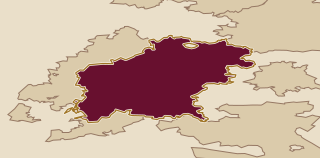
The vineyards sit beside the Tagus in Tejo, a region where the river moderates vineyards closest to it and brings marked day-to-night temperature change. In a white such as Verdelho, that setting helps account for a dry, light-bodied style with citrus, orange blossom and lively acidity rather than a heavy, tropical palate. Tejo can appear on a label as Vinho Regional Tejo or DoTejo DOC, placing the bottle within the river-valley region rather than identifying one village vineyard.
Quinta da Alorna works both campo, the fertile plains beside the river that can flood periodically, and charneca, land associated with sandy, rolled-stone, lower-fertility soils. The supplied vineyard description also names sandy loam and sandy clay, so the estate’s ground is not one uniform soil type. Sandy sites and river conditions suit both red and white grapes; in the documented whites, the result is fruit with enough freshness and mineral cut to carry aromas such as grapefruit, lemon and herbs.
In the cellar
Vineyards and cellar
The vines are trained in Double Cordon de Royat, and grapes are harvested according to variety, ripeness, soil and weather conditions, by hand and machine. Integrated viticulture and separate vinification keep individual varieties distinct before blending decisions are made. For a Sauvignon Blanc, this helps preserve the grape’s pineapple, grapefruit, guava and green herbal notes instead of folding them into a generic white-wine profile.
White grapes are pressed and fermented without skins, while red grapes ferment with skins for colour and tannin. Temperature-controlled stainless steel and native yeasts support clean fruit expression; selected wines also see French oak and fine lees. The contrast is audible in the glass: Verdelho remains dry and bright, while oak-fermented Alvarinho & Viognier gains a broader body, softer edges and a creamy mid-palate.
Wines to know
The range in view
The white range has three distinct steps. Quinta da Alorna Verdelho is a single-variety Tejo white built for freshness: lemon, passion fruit, light herbs, acidity and a persistent finish. Sauvignon Blanc takes a more outwardly aromatic route, with pineapple, grapefruit, guava, asparagus and freshly cut grass, but its mineral line and structure keep the fruit dry in feel.
Alvarinho & Viognier Reserva changes the shape of the range rather than merely adding another aroma. Alvarinho brings tropical fruit; Viognier contributes apricot, flowers and Williams pear; fermentation in oak adds creamy texture and broader weight. The estate also grows Touriga Nacional, Tinto Roriz, Cabernet Sauvignon and Alicante Bouschet for reds, plus Fernão Pires, Arinto and Chardonnay, but the supplied bottle detail is richest for these three whites.
A useful way in
A bottle to begin with
Choose Quinta da Alorna Verdelho first. It is a dry, light-bodied, single-variety Tejo white whose lemon, orange blossom, passion-fruit and herbaceous notes are carried by vibrant acidity and a lightly textured finish. This bottle puts the Tagus-side setting and the estate’s white-wine handling in direct view: ripe fruit arrives, but citrus, pith and freshness remain central. It also establishes a useful baseline before moving to the greener Sauvignon Blanc or the oak-fermented, creamier Alvarinho & Viognier Reserva.