
Why it matters
The producer
The company grew from a restructuring of family vineyards begun roughly a decade before its formal founding. Bottling followed after 1985, when the first Arca Nova wines put the family’s production under its own label. The result is a producer with vineyard roots and an in-house route from harvest through bottling, rather than a range built only around purchased wine.
Quinta das Arcas now reports about 220 hectares of wine-production holdings in Vinho Verde and 200 hectares in Alentejo. The southern vineyards widen the company’s Portuguese footprint, but Sobrado and its white-grape plantings keep Vinho Verde at the centre of this page.
Place and vineyards
Where the wines begin
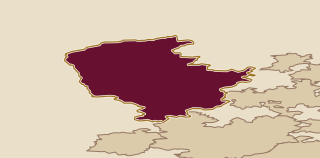
Sobrado lies inland from the Atlantic, between Valongo and Paredes. At the principal estate, around 60 hectares are planted chiefly to Loureiro, Trajadura and Arinto—grapes associated here with fresh white wine and acidity. Alba Rhino narrows the location further: its Alvarinho comes from Sobrado vineyards about 20 kilometres from the ocean, a setting reflected in a very fresh, citrus-led style.
Vinho Verde is not presented as one fixed recipe. At Quinta das Arcas, the regional grape base supports several bottle types: aromatic still Alvarinho, a separate Conde Villar Alvarinho Superior, and an Arinto sparkling wine made by the traditional method.
In the cellar
Vineyards and cellar
Many vines at the principal Sobrado estate are around 30 years old, with Loureiro, Trajadura and Arinto forming the main planting. Across its vineyards, Quinta das Arcas reports an integrated environmental production system. In practical terms, the estate’s vineyard work is paired with white varieties selected for fresh wine and with cellar handling that preserves fruit and acidity.
Alba Rhino receives lees stirring during fermentation. Contact with the spent yeast adds body and texture to its Alvarinho fruit, so pear, peach and lemon do not arrive as a thin, simple rush. The 2021 Quinta das Arcas Espumante takes yeast contact further: traditional-method production and 18 months on lees before disgorgement bring toast and French nougat alongside Arinto’s fresh acidity.
Wines to know
The range in view
The range has distinct lanes rather than one uniform Vinho Verde style. Alba Rhino is a still Alvarinho from Sobrado, with lees work adding texture to a fresh, fruit-led white. Conde Villar Alvarinho Superior is another named Alvarinho bottling and remains separate from Alba Rhino in origin and cellar description.
Quinta das Arcas Espumante, 2021, shifts the focus to Arinto and bubbles. It is certified organic, made by the traditional method and aged on lees for 18 months before disgorgement. Its red-apple and grapefruit fruit sits with honey, toasted bread and nougat, while the mousse carries those flavours across the palate.
A useful way in
A bottle to begin with
Choose Alba Rhino Vinho Verde. It is a still Alvarinho from Sobrado vineyards about 20 kilometres from the Atlantic, fermented with lees stirring. Pear, green apple, peach and lemon show the wine’s fruit; fresh acidity and a fuller lees-shaped texture show how the cellar handles it. It places one grape, one named site and one production choice in the same bottle.