
Why it matters
The producer
Viticulture Professor Rogério de Castro renewed Quinta de Lourosa in recent decades with his daughter and winemaker Joana de Castro. Joana de Castro is in charge together with her father, while his wife, children, and grandchildren participate in everyday farm tasks. Annual grape production is roughly 300,000 kilograms. The property includes a chapel from the 17th century and farmhouse eaves from the 18th century.
Quinta de Lourosa became known for pioneering the LYS vine training method. The system improves sun exposure and supports the growth of sound, ripe grapes. It also reduces the season's phytosanitary treatment requirement by two applications.
Place and vineyards
Where the wines begin
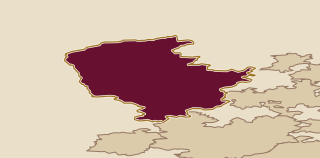
At 40 kilometres from Porto, the estate sits in Sousela, in the Sousa River valley, on the Vinho Verde Route. The vineyards have granitic soils, described as somewhat more fertile than those of the Dão region.
The wine names use two forms of information: Vinho Verde is a regional designation, and Alvarinho is a grape variety.
Wines to know
The range in view
The two named white wines are Alvarinho Quinta de Lourosa 2020 and Quinta de Lourosa Vinho Verde 2024. The first puts the Alvarinho grape on the label, while the second uses the Vinho Verde designation.
A separate 2007 Quinta de Lourosa Vinho Verde Branco was a blend of 70% Arinto and 30% Loureiro. It showed a smoky, mineral edge on the nose, with lemon and grapefruit on a bright, focused palate and some spritz.