
Why it matters
The producer
The name comes from Francisco Ferreira, known as Pôpa. His son José Ferreira, known as Zeca do Pôpa, acquired part of Quinta do Vidiedo in Adorigo, Tabuaço, turning a family ambition into a named estate. That origin remains close to the bottles: the Pôpa name sits on wines made from a compact Douro site rather than a broad regional blend assembled from unnamed vineyards.
José Ferreira’s acquisition of part of Quinta do Vidiedo gave the family a foothold in Adorigo, Tabuaço. Later, Luís Pato, the Bairrada winemaker and family friend, brought technical knowledge and encouraged the third generation to develop the project. Stéphane and Vanessa Ferreira became actively involved in 2010, bringing a younger direction that can be seen in the coexistence of a blended Douro white and a limited wine made in amphora.
Place and vineyards
Where the wines begin
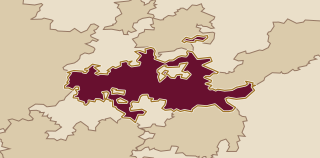
The estate lies in northeastern Portugal, within the Douro Valley DOC and the Cima Corgo subregion, on the river’s left side. In a warm Douro setting, grapes can reach ripe fruit character; Contos da Terra Branco shows that ripeness through yellow apple, white peach and apricot, while grilled lemon keeps citrus in the picture.
Quinta do Pôpa describes its ground as schist with nutrient content and water-retention properties. That matters on a small property where four hectares of old vines dated from 1932 were recorded in 2003: vines rooted in this rock work from a site able to hold water, while the resulting whites retain a mineral thread beside their stone-fruit fruit.
In the cellar
Vineyards and cellar
In 2003, the property comprised nine hectares, including six hectares of vines and four hectares of old vines from 1932. That limited vineyard base places attention on the material already in the ground, rather than on a large estate’s many separate sites; old-vine fruit is part of the estate’s documented foundation.
The cellar direction changes with the bottle. Pôpa Amphora Branco revives amphora vinification as a limited edition: for the documented 2019 wine, grapes underwent pre-fermentation maceration, fermented with solids in amphora, then aged on full lees. Skin contact, solids and lees bring more body and texture than a straightforward fruit-only white, while amphora avoids making oak the defining flavour.
Wines to know
The range in view
The confirmed range offers two distinct white-wine routes. Pôpa Contos da Terra Branco 2024 is a six-variety blend containing 30% Viosinho. Its fruit-and-citrus profile—yellow apple, white peach, grilled lemon and apricot—makes it the more immediate expression, with mineral notes placing the blend back in its schist setting.
Pôpa Amphora Branco takes a different route through the cellar. It is a limited-edition wine built around ancestral amphora vinification, maceration and lees ageing, so its interest is structural as much as aromatic: more texture, more contact with the solids, and acidity documented as part of its shape. These are not interchangeable labels; Contos da Terra presents the blended Douro-white side, while Amphora Branco tests how the same regional context behaves in clay.
A useful way in
A bottle to begin with
Start with Pôpa Contos da Terra Branco 2024. It is a six-variety Douro white with 30% Viosinho, and its documented yellow apple, white peach, grilled lemon, apricot and mineral character makes the estate’s core materials easy to follow in one glass. The fruit shows the Douro setting; the citrus and mineral notes keep the wine from reading as merely ripe. Amphora Branco can come next, when the question is how maceration and lees change texture.