
Why it matters
The producer
Quinta do Tamariz links its modern history to banker António Borges in the late nineteenth century, while the estate’s important wine-development phase began under D. Lúcia Borges Vinagre in 1926. In that same year, SAQSM—Sociedade Agrícola da Quinta de Santa Maria, SA—was created to manage Quinta do Tamariz and Quinta de Santa Maria. The result is an estate whose bottles sit within a long-running family property rather than a label assembled from anonymous fruit.
The estate’s story has several distinct turns. António Borges anchors the late-nineteenth-century legacy; D. Lúcia Borges Vinagre then led a major phase of wine development from 1926. Quinta do Tamariz was purchased in 1939 and became her residence, joining domestic life and vineyard property at the same address. The wine consequence is continuity across a family estate whose present range still includes still wine, sparkling wine and aged brandy.
Place and vineyards
Where the wines begin
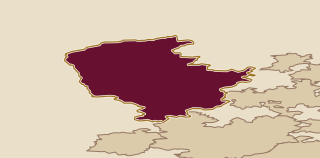
The estate is in Carreira, Barcelos, with family land in S. Miguel da Carreira. Those place names matter most on a bottle marked Vinho Verde: they locate the producer inside the region while the 2022 Alvarinho Reserva narrows the focus further to a wine made entirely from Alvarinho. Rather than asking one regional name to explain every bottle, Tamariz separates its still Alvarinho from Loureiro and Touriga Nacional Pet Nat wines.
No named soil, slope or exposure is attached to the supplied estate material, so Quinta do Tamariz’s ground should not be dressed up with borrowed Vinho Verde scenery. The firm site fact is its 35 hectares of vineyards around Carreira and Barcelos. That scale supports an estate-fruit approach, tying the fruit behind the Alvarinho Reserva and the Pet Nat wines to a defined holding rather than an unspecified regional blend.
In the cellar
Vineyards and cellar
Estate fruit is central to the Tamariz range, with 35 hectares providing the material for wines that take different routes in the cellar. The 2022 Alvarinho Reserva is made exclusively from Alvarinho, so its fruit, fermentation and ageing belong to one grape rather than a blended recipe. That single-variety structure makes it a useful still-wine expression alongside the estate’s sparkling releases.
The Pet Nat wines demand a different decision: the moment of bottling matters because fermentation continues in the bottle and creates mousse. Sofia Lobo has described this judgement as particularly important for Touriga Nacional Pet Nat. Tamariz also makes wine brandy aged in Limousin oak, where wood ageing adds an oak-led element of texture and finish that has no equivalent in the fresh, sparkling wines.
Wines to know
The range in view
The range is built in three forms. Still wine includes the 2022 Alvarinho Reserva, a Vinho Verde made entirely from Alvarinho. Its role is structural: one grape in a still wine, without the mousse of a sparkling bottle or the oak ageing used for brandy.
Sparkling wine brings white Loureiro Pet Nat, rosé Pet Nat and Pet Nat made from Touriga Nacional into the picture. These are not simply fizzy versions of the still range: bottle fermentation makes mousse part of their body and texture, while Loureiro and Touriga Nacional keep grape character in view. The white Loureiro Pet Nat is documented at 13% alcohol for the 2021 vintage; that number should stay with that bottle and vintage alone.
A useful way in
A bottle to begin with
Start with Quinta do Tamariz Alvarinho Reserva 2022. It is a Vinho Verde made exclusively from Alvarinho, so it isolates one grape in the estate’s still-wine range before the added mousse of Pet Nat or the oak ageing of brandy enters the picture. On the palate, look first for the wine’s still texture, acidity and finish; its one-grape composition makes those structural details easier to separate from the bottle-fermented sparkle found elsewhere in the range.