
Why it matters
The producer
Quinta Vale D. Maria began making its own wines in 1996, after an earlier life supplying grapes to Port producers. The estate now belongs to Aveleda, but its bottles remain anchored to a named quinta, a defined Douro place and a cellar where granite lagares are still used for premium red wines.
The producer’s most distinctive bottle is Vinha da Francisca. Its name refers to a single vineyard, not an anonymous estate blend, and the five-grape planting gives the wine a broader Douro vocabulary than a single-variety label would. The bottle is red, deeply coloured and built for the table as much as for the cellar.
Place and vineyards
Where the wines begin
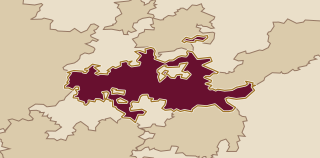
The quinta sits in the Rio Torto valley, in the Douro. That location gives the label a useful sequence: Quinta Vale D. Maria names the estate, Douro names the regional wine place, and Vinha da Francisca identifies the vineyard behind the bottle. The grape list then tells you how the wine was assembled in the vineyard.
This is a producer where place is carried through estate names and vineyard names. Vinha da Francisca does not ask the label to hide behind a broad regional blend. It puts a specific 4.5-hectare parcel at the centre, then combines the five varieties planted there into one red wine.
In the cellar
Vineyards and cellar
Grapes are harvested by hand, then trodden in traditional granite lagares. For premium red wines, the lagar is part of the cellar method and part of the wine’s physical story: grape skins, juice and human foot pressure meet in an open granite vessel before the wine continues its making.
The vineyard work also extends beyond the vine rows. Ground cover, biodiversity refuges and fruit trees occupy the spaces between vineyard areas. That arrangement keeps the estate’s farming visible as a living property, while the hand harvest and granite lagares bring the red wines back to grape selection and extraction.
Wines to know
The range in view
The secure range centres on red wines, with Vinha da Francisca as the named single-vineyard expression. Its five varieties are Tinta Francisca, Touriga Nacional, Touriga Franca, Rufete and Sousão. The wine is intensely coloured, carries dark red fruit, floral and spice notes, and has firm tannins with a persistent finish.
Vinha da Francisca also spends 20 months in new French oak, giving the bottle a clear cellar signature alongside its vineyard and grape blend. Its stated ageing potential is 5 to 20 years after bottling. The wider premium red category is linked to hand harvesting and granite-lagar treading, but the supplied range does not establish a complete list of additional cuvées, colours or cellar treatments.
A useful way in
A bottle to begin with
Start with Quinta Vale D. Maria Vinha da Francisca. It is a red wine from the estate’s distinct 4.5-hectare vineyard, planted in 2004 with Tinta Francisca, Touriga Nacional, Touriga Franca, Rufete and Sousão. The deep colour, dark fruit, floral lift, spice and broad tannins give the five-grape planting a clear voice, while 20 months in new French oak adds a marked cellar frame. It is the right first bottle because vineyard, grape mix and ageing method all appear on one label.