
Why it matters
The producer
Amadeu Abílio Lopes founded Quintas de Melgaço after recognising the importance of Alvarinho in the region. The company was created in 1990 and began operating in 1994, with a practical purpose: to unite hundreds of small and medium winegrowers around a shared wine company. That collective origin still shapes how the range is understood. The bottles are rooted in Melgaço, but they draw on grapes from a network of different quintas rather than a single named estate.
Lopes had gone to Brazil in the middle of the 20th century and became a prominent industrialist there. His return to the wine map of Melgaço connected an international commercial life with a local grape. Alvarinho provides the through-line, while the range tests several ways of presenting it, from an older vineyard to a multi-vintage blend and a sparkling wine.
Place and vineyards
Where the wines begin
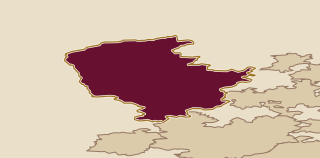
Melgaço lies close to the Atlantic, but its mountains protect the vineyards from maritime winds. The vineyards sit at mid-slope in a natural amphitheatre cooled by the Minho River. Altitude, rainfall, temperature, and hours of sunshine are all presented as conditions that help Alvarinho ripen.
That combination gives the place two useful directions. The river and mountain setting help preserve freshness, while the protected position allows the grapes to reach fuller ripeness. The label Vinho Verde therefore leads here to a northern Melgaço reading of Alvarinho, with place and grape working together in the bottle.
In the cellar
Vineyards and cellar
The vineyard network is the defining practical fact. Quintas de Melgaço represents 530 growers from different quintas, all connected to the Melgaço region. Their vineyards occupy the mid-slope amphitheatre cooled by the Minho River, where mountain shelter, altitude, rainfall, temperature, and sunshine shape ripening.
The range is easier to read through declared grape, vineyard age, blending choice, and format than through cellar technique. QM Alvarinho Vinhas Velhas names a vineyard more than 30 years old. QM Patriam combines Alvarinho from four separate harvests. The Sauvignon Blanc bottling changes the grape blend, while Espumante Reserva changes the format. Oak, lees ageing, fermentation vessels, dosage, and harvest methods are not established here.
Wines to know
The range in view
QM Alvarinho Vinhas Velhas is the most specific still white in the range. It is made from Alvarinho grown in a vineyard more than 30 years old, and its published profile gives a full mouth, fruity flavour, balanced acidity, and a long, persistent finish. The bottle connects the region’s defining grape with a named age-of-vines detail.
QM Alvarinho Barro remains a single-grape Alvarinho white. Its profile is presented through colour, aroma, freshness, texture, and finish, giving it a direct place within the still-white range even though the detailed descriptors are not available here.
A useful way in
A bottle to begin with
Start with QM Alvarinho Vinhas Velhas. It is Alvarinho from a vineyard more than 30 years old, with a full and fruity mouth, balanced acidity, and a long, persistent finish. The bottle brings together the grape that prompted Lopes to found the company, the older-vine detail that separates it from a general regional white, and a clear sequence from ripe fruit to lasting acidity.